Share our site:

SHARE

213
Optics. ZAHN. Oculus artificialis teledioptricus sive telescopum.
1702
EUR 6.000,00
Base d'asta
EUR 7.000,00 / 8.000,00
Stima
Descrizione
Optics. ZAHN. Oculus artificialis teledioptricus sive telescopum.
1702
1702
ZAHN, Johannes. Oculus artificialis teledioptricus sive telescopum.
Nuremberg, Johann Christoph Lochner, 1702
Rara seconda edizione ampliata della prima opera interamente dedicata alla storia del telescopio. Opera riccamente figurata. Norman: “Zahn's treatise contains the first complete history of early microscopes. The work is particularly valuable for its illustrations of both simple and compound microscopes of the period, including the type of compound instrument used by Robert Hooke”.
L’opera è divisa in tre parti principali: la prima è dedicata all'astronomia in generale, fornendo una panoramica storica della percezione dei colori, delle diverse qualità delle lenti convesse e concave, della loro rifrazione e della loro qualità; la seconda parte tratta della produzione e dell'uso di lenti e strumenti ottici; la terza parte contiene i risultati delle sue ricerche e le loro varie applicazioni.
Il primo capitolo è preceduto da una bibliografia degli autori citati (Leeuwenhoek, Maignan, Galileo, Hevelius, Keplero, Camerarius, Hooke e altri).
Riccamente illustrata, l’opera copre tutti gli aspetti dell'ottica dalle origini fino alla fine del XVII secolo.
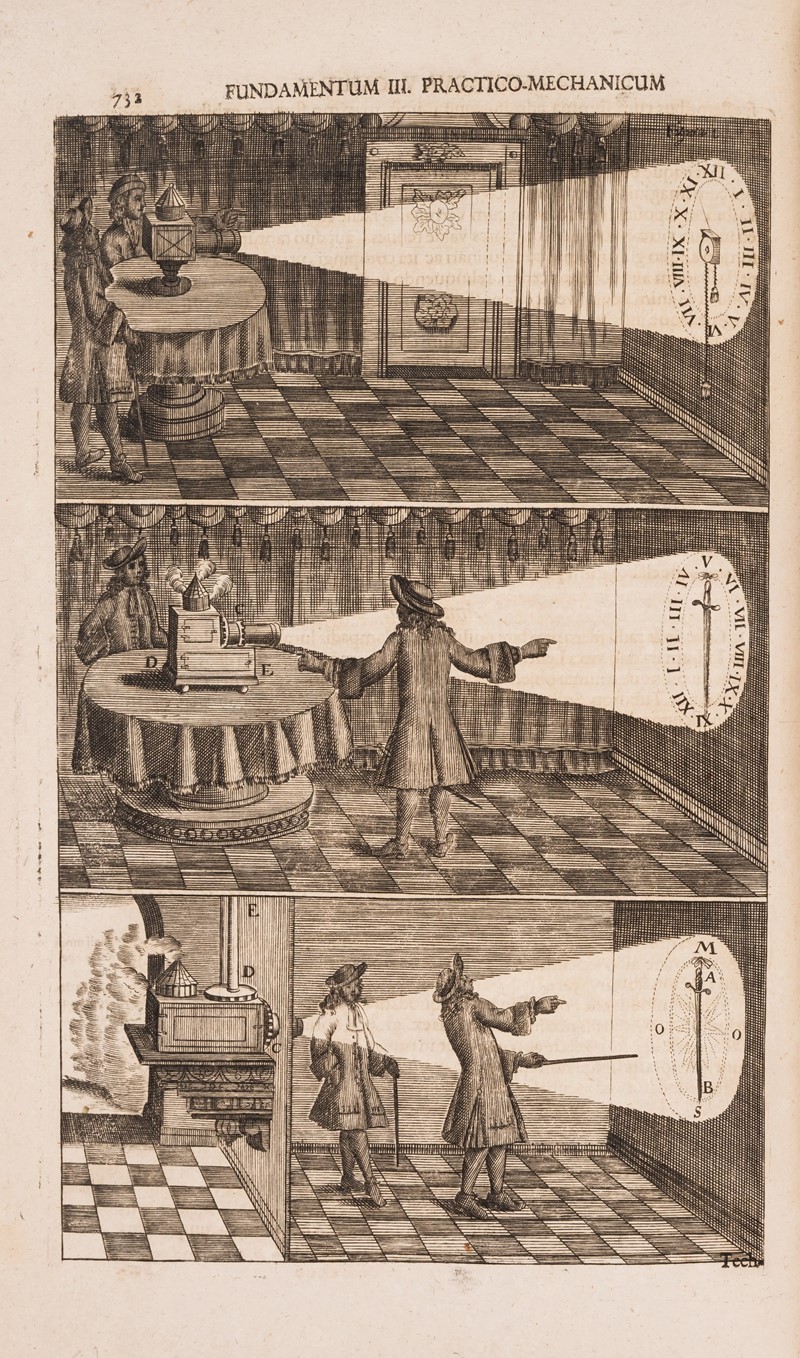
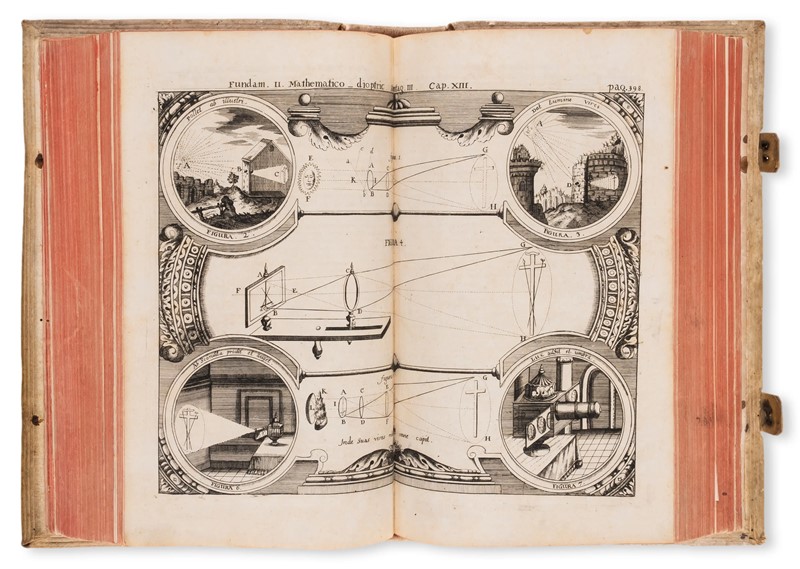
Le grandi tavole ripiegate mostrano magnifici esempi del loro utilizzo, come la carta solare di Kircher e la carta lunare di Cherubini, con la loro storia osservativa inclusa nel testo (ad esempio, Keplero, Galileo, Hevelius), nonché due grandi sistemi ciclici, il "Panscopium" e il "Chronoscopium". Le illustrazioni incise e xilografiche nel testo dimostrano in modo superbo la costruzione e l'applicazione degli strumenti, delle loro lenti e degli altri componenti: riproducono esperimenti, lenti e le loro rifrazioni, lanterne magiche, telescopi, strumenti prospettici, ecc.
Questo esemplare contiene una tavola incisa ripiegata supplementare, con un complesso albero genealogico: in basso al centro campeggia l’elaborato stemma della famiglia Greiffenklau, di antica nobiltà tedesca.
Johann Zahn (1631–1707) fu canonico del monastero premonstratense di Oberzell (Baviera) e insegnò matematica all'Università di Würzburg. Esperto di spicco in ottica e astronomia, migliorò sostanzialmente il telescopio raddrizzatore sviluppato nel 1676 da Johann Sturm, dotandolo di un oculare acromatico mediante doppietti di lenti convesse e concave. Concentrò la luce dipingendo di nero le pareti della camera riflettente, una tecnica oggi considerata il primo passo verso la macchina fotografica.
Blake 498; Roller-G. II, 602; Poggendorff II, 1390; Duncan 15151; Berge, Thomas Vroom 396; vgl. Becker Coll. 424.
Vedi Garrison-Morton, 263 e Norman 2278 (per l'edizione originale del 1685/86).
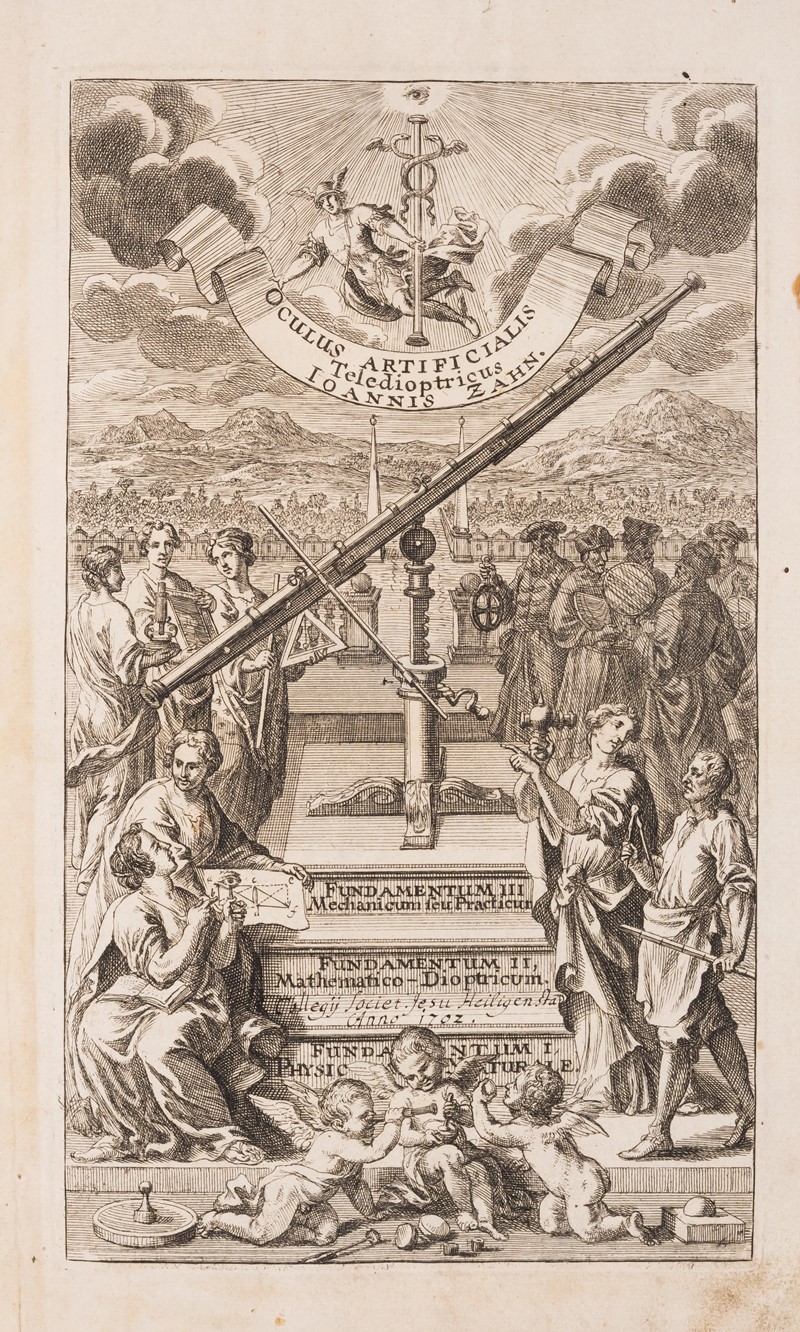
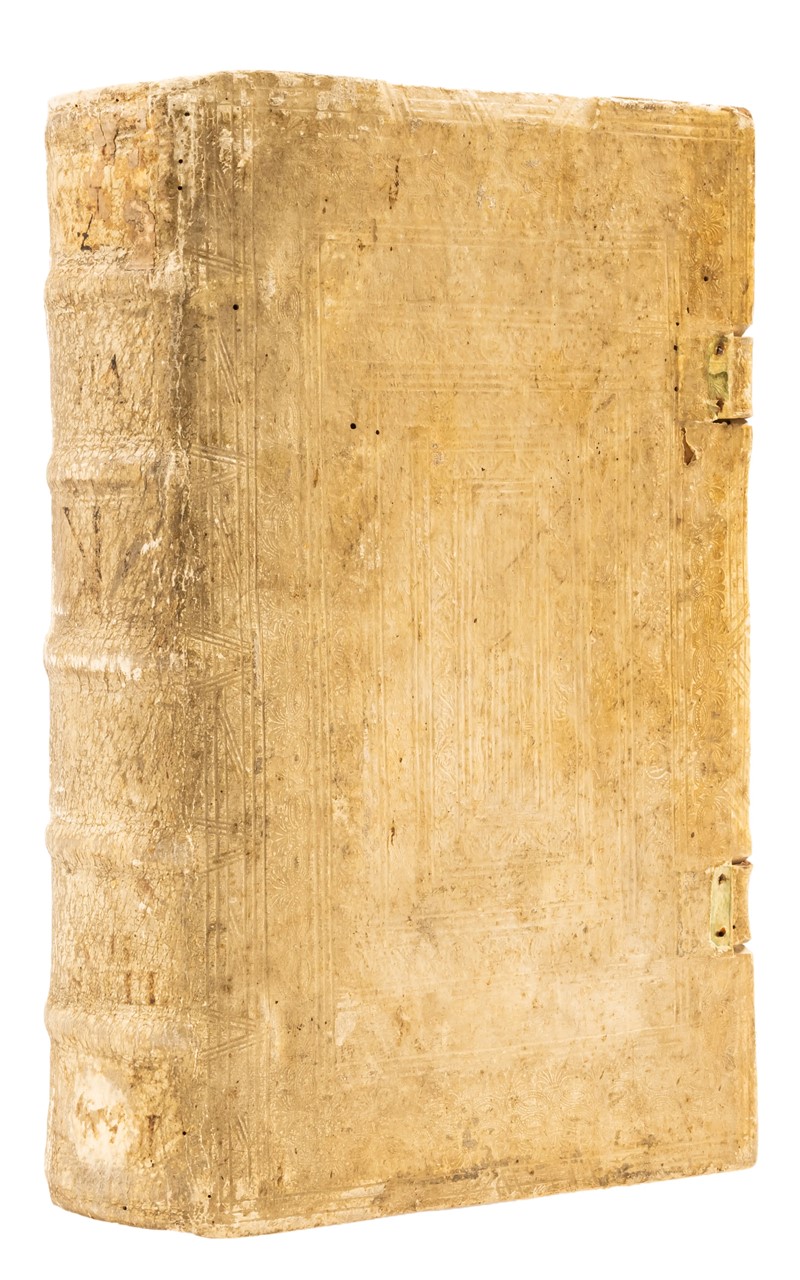
In-folio. 325x210 mm. Legatura coeva in pelle di maiale con impressioni a secco su tavole di legno, resti di 2 fermagli. Antiporta allegorica incisa su rame, Fogli 20 non numerati, inclusi il frontespizio in rosso e nero e il ritratto inciso, 797 pagine, 8 fogli non numerati. Numerose illustrazioni nel testo di diverse dimensioni incise in rame e in xilografia. 7 Tavole fuori testo incise su rame su doppia pagina o ripiegate, 12 incisioni su rame a piena pagina nel testo, 10 xilografie a piena pagina nel testo, 7 tavole tipografiche su doppia pagina fuori testo.
Ex-libris “Bibliotheca Opticoria di David L DiLaura” incollato al contropiatto; antica iscrizione di proprietà sul Frontespizio e sulla carta 5N4v.
Lievi tracce d’uso alla legatura, piccole riparazioni sul verso del margine dell’Antiporta, difetto della carta sul margine di pagina 99 con perdita di qualche lettera, qualche brunitura e qualche piccola macchia, comunque generalmente buono,
In totale, Antiporta, Ritratto, 7 tavole fuori testo su doppia pagina o ripiegate, tutto inciso in rame. Inoltre, 7 tabelle tipografiche ripiegate fuori testo, numerose illustrazioni incise e xilografiche nel testo, alcune a piena pagina.
Condition Report
ZAHN, Johannes. Oculus artificialis teledioptricus sive telescopum.
Nuremberg, Johann Christoph Lochner, 1702
Rare second, enlarged edition of the first work entirely devoted to the history of the telescope. Richly illustrated. Norman: “Zahn's treatise contains the first complete history of early microscopes. The work is particularly valuable for its illustrations of both simple and compound microscopes of the period, including the type of compound instrument used by Robert Hooke.”
The work is divided into three main parts: the first is devoted to astronomy in general, providing a historical overview of color perception, the different qualities of convex and concave lenses, their refraction, and their quality; the second part deals with the production and use of lenses and optical instruments; the third part contains the results of his research and their various applications.
The first chapter is preceded by a bibliography of the authors cited (Leeuwenhoek, Maignan, Galileo, Hevelius, Kepler, Camerarius, Hooke, and others).
Richly illustrated, the work covers all aspects of optics from its origins to the end of the 17th century.
The large folded plates show magnificent examples of their use, such as Kircher's solar chart and Cherubini's lunar chart, with their observational history included in the text (e.g., Kepler, Galileo, Hevelius), as well as two great cyclic systems, the "Panscopium" and the "Chronoscopium." The engraved and woodcut illustrations in the text superbly demonstrate the construction and application of the instruments, their lenses, and other components: they depict experiments, lenses and their refractions, magic lanterns, telescopes, perspective instruments, etc.
This copy contains an additional folded engraved plate, with a complex family tree: at the bottom center is the elaborate coat of arms of the Greiffenklau family, an ancient German nobility.
Johann Zahn (1631–1707) was a canon of the Premonstratensian monastery of Oberzell (Bavaria) and taught mathematics at the University of Würzburg. A leading expert in optics and astronomy, he substantially improved the erecting telescope developed in 1676 by Johann Sturm, equipping it with an achromatic eyepiece using doublets of convex and concave lenses. He concentrated the light by painting the walls of the reflecting chamber black, a technique now considered the first step towards the photographic camera.
Blake 498; Roller-G. II, 602; Poggendorff II, 1390; Duncan 15151; Berge, Thomas Vroom 396; vgl. Becker Coll. 424.
Vedi Garrison-Morton, 263 e Norman 2278 (for the first edition of 1685/86).
In-folio. 325 x 210 mm. Contemporary pigskin binding with blind tooling on wooden boards, remnants of 2 clasps. Allegorical frontispiece engraved on copper, 20 unnumbered leaves, including the red and black title page and the engraved portrait, 797 pages, 8 unnumbered leaves. Numerous illustrations on the text of various sizes, copper-engraved and woodcut. 7 copper-engraved plates outside the text, on a double-page spread or folded, 12 full-page copperplates in the text, 10 full-page woodcuts in the text, 7 typographic plates outside the text on a double-page spread.
Bookplate "Bibliotheca Opticoria by David L. DiLaura" glued to the inside cover; old ownership inscription on the title page and on leaf 5N4v.
Slight traces of wear on the binding, small repairs on the verso edge of the frontispiece, paper defect in the margin of page 99 with loss of some letters, some browning, and a few small stains, otherwise generally good.
In total: Frontispiece, Portrait, 7 plates in the text on a double page or folded, all copperplate engravings. Additionally, 7 typographical plates folded outside the text, numerous engraved and woodcut illustrations in the text, some full-page.
Bibliografia
Blake 498; Roller-G. II, 602; Poggendorff II, 1390; Duncan 15151; Berge, Thomas Vroom 396; vgl. Becker Coll. 424.
Vedi Garrison-Morton, 263 e Norman 2278 (per l'edizione originale del 1685/86).
mar 9 Giugno 2026
Orari Asta
Via dei Soncin, 28
35122 PADOVA
ESIBIZIONE: 3-5 Giugno 2026 solo su appuntamento.
Per prenotare il vostro appuntamento chiamare il numero 049 8755317 o mandare una email a info@badoemart.it
Ricordiamo che il nostro staff rimane a vostra disposizione per eseguire condition report dettagliati con foto aggiuntive a quelle già presenti in catalogo.

Bado e Mart
https://www.badoemart.it/img-footer/logo.png
Bado e Mart Srl
Via Dei Soncin, 28
35122 Padova Veneto Italy
Tel. +39 049 8755317
Fax +39 049 8755317
E-mail: info@badoemart.it
Partita IVA IT00773300280
35122 Padova Veneto Italy
Tel. +39 049 8755317
Fax +39 049 8755317
E-mail: info@badoemart.it
Partita IVA IT00773300280
Follow us on
Copyright Bado e Mart 2018. All rights reserved.
Realized by Thetis Srl
Realized by Thetis Srl