Share our site:

SHARE
18
BRANT - DURER - BADE. Nauis stultifera a domino Sebastiano Brant primu[m] edificata.
1507
EUR 8.000,00
Base d'asta
EUR 10.000,00 / 12.000,00
Stima
Descrizione
BRANT - DURER - BADE. Nauis stultifera a domino Sebastiano Brant primu[m] edificata.
1507
1507
BRANT, Sebastian - DURER, Albrecht - BADE, Josse. Nauis stultifera a domino Sebastiano Brant primu[m] edificata …
Basilea, Nikolaeus Lamparter, 15 Marzo 1507
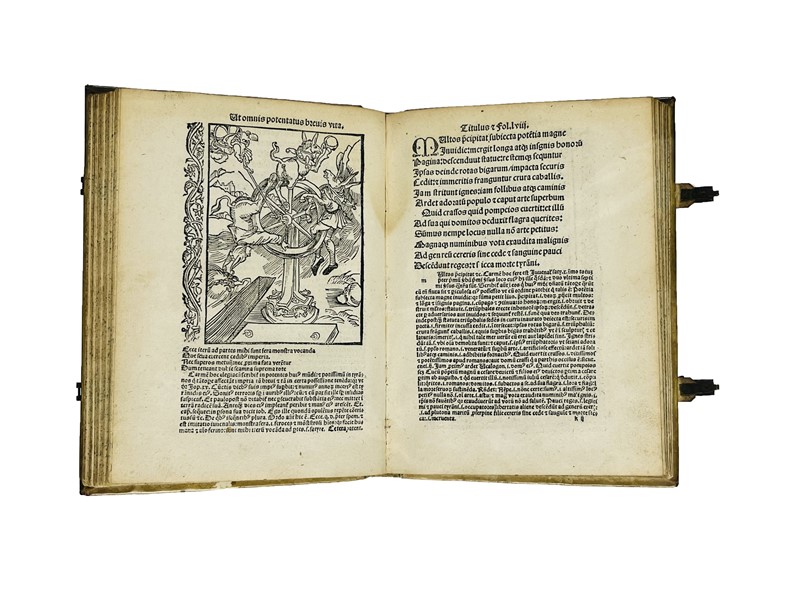
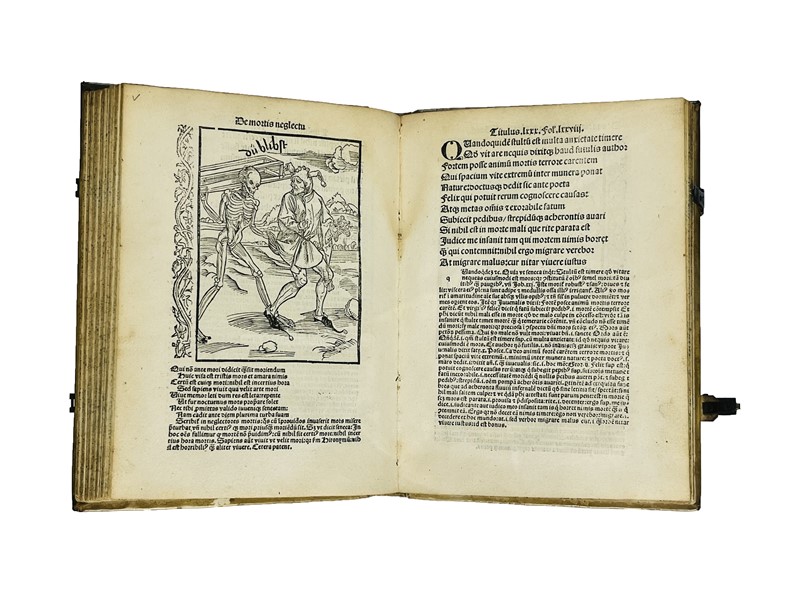
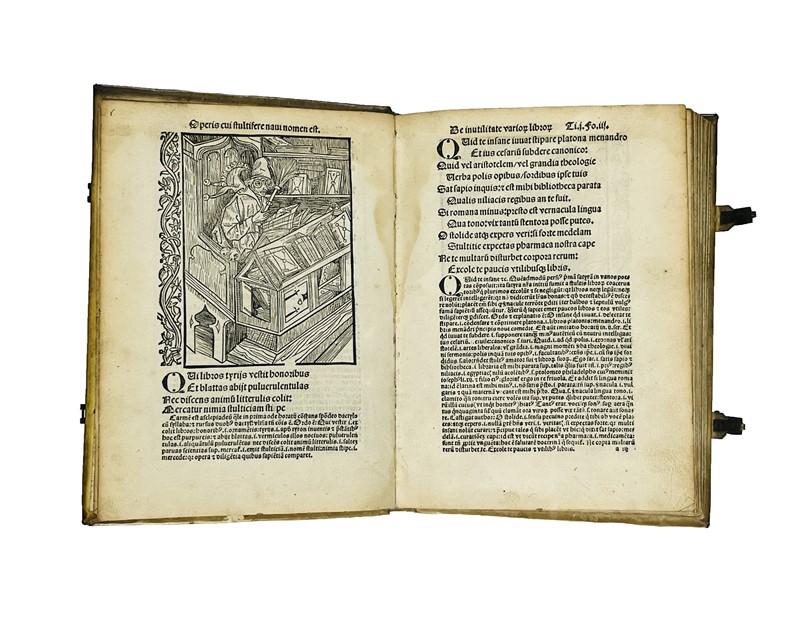
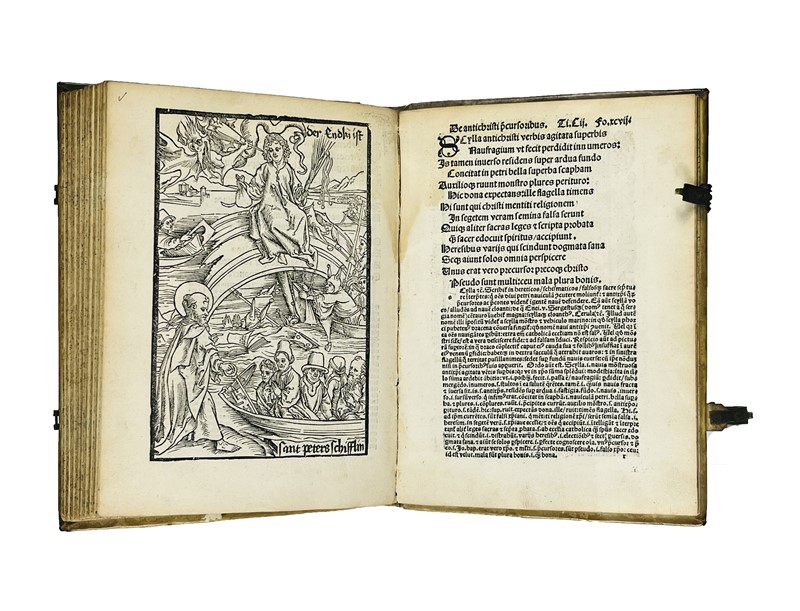
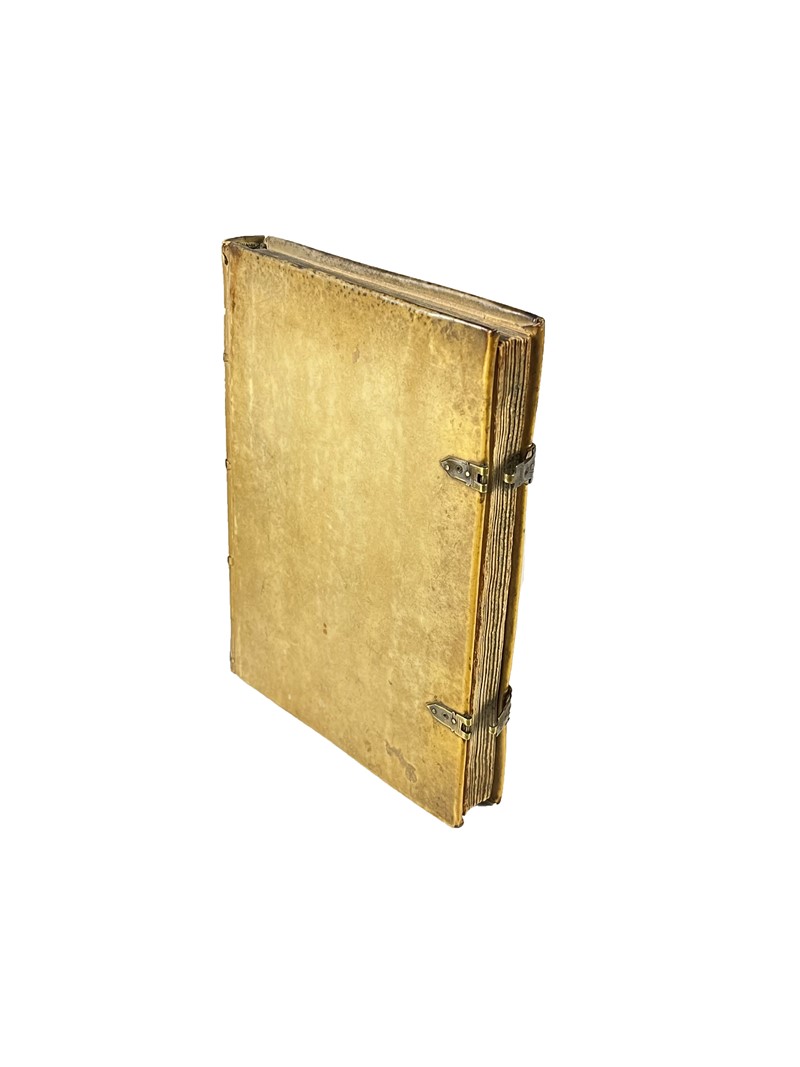
In 4to. 204x145 mm. Legatura del XVII secolo, pergamena rigida, dorso liscio con titolo manoscritto, fermagli in ottone e pelle, tagli a spruzzo. Carte Cvii, [1]. Il titolo continua con “& lepidissimis Teutonice lingue rithmis decorata: deinde ab Iacobo Lochero philomuso Latinitate donata: & demum ab Iodoco Badio Ascensio vario carminum genere non sine eorundem familiari explanatione illustrata.” Colophon sul recto dell’ultima carta non numerata “Impressum Basilee p[er] Nicolaum Lamparter, M.cccccvij. Die xv. mensis Martij”. Frontespizio in rosso e nero con illustrazione che raffigura la nave, Marca tipografica sotto il Colophon, 115 xilografie nel testo, inclusa quella del titolo, una piena pagina, le altre di tre quarti di pagina, bordate da un fregio decorativo.
Antica nota manoscritta di appartenenza sul Frontespizio “Heggeling”; sul contropiatto, Ex libris araldico inciso “Hog of Newliston”. Abile restauro al Frontespizio, pallida gora sul margine di alcune carte, in complesso bell’esemplare.
Rarissima seconda edizione figurata di Basilea, con le magnifiche xilografie di Albrecht Dürer.
Comparsa per la prima volta a Basilea nel 1494, in occasione del clamoroso Carnevale altorenano Das Narrenschiff (La nave dei folli) dell’umanista Sebastian Brant (Strasburgo 1458 – 1521) è un'opera satirica in tedesco alsaziano composta da una serie di 112 satire brevi, e corredata da numerose xilografie. Viene ricordata anche perché molte illustrazioni furono eseguite da Albrecht Dürer, già attivo a Basilea negli anni precedenti; le rimanenti si devono al cosiddetto Haintz-Nar-Meister, lo Gnad-Her-Meister, e altri due anonimi artisti.
Josse Bade (1462-1535) reinterpreta il testo di Brant e lo rielabora con commenti originali: suddivide il testo in 113 parti in versi, ciascuna accompagnata da una spiegazione in prosa che si discosta significativamente dal testo di Brandt. Ogni capitolo in versi è inoltre accompagnato da una delle magnifiche xilografie e da una poesia. Le poesie sono spesso tratte da classici come Virgilio, Orazio e Giovenale, ma anche da Battista di Mantova.
Questa è la quinta edizione latina della Nave dei Folli, con le xilografie di Dürer stampate dai blocchi originali del 1494, ed è la seconda edizione di Lamparter, che aveva acquistato i blocchi da Bergmann. Le xilografie (probabilmente 73) attribuite al giovane Dürer sono identificabili dai cappelli da giullare ornati di campanelli. Come indicato nel Frontespizio, la traduzione dal tedesco al latino fu intrapresa da Jakob Locher (1471–1528), allievo di Brant che lavorò a Ingolstadt. Contribuì così alla diffusione internazionale dell'opera, precedentemente nota solo a livello regionale; la sua traduzione latina costituì la base testuale per quasi tutte le edizioni in lingua straniera.
Esemplare di prestigiosa provenienza, appartenuto a Johann Heinrich Eggeling, 1639-1713, segretario del consiglio di Brema, storico poliedrico di grande importanza, numismatico e culture dell’antichità classica, autore di numerose opere. Il suo nome è vergato a inchiostro sul titolo, con le parole: "Ministerium Joh. Henr. Eggeling"
Appartenuto in seguito a Helen Maitland Gibson, figlia di Sir Alexander Charles Maitland, baronetto di Clifton Hall, e moglie di Jules Maitland Hog di Newliston (1799-1858), avvocato e proprietario terriero scozzese. Il suo ex libris araldico, con motto ‘Dat Gloria Vires’, è inciso da Benjamin Wion (1802-1858).
Adams B 2672; Goedeke I, 387, 7; Meder S. 276; VD16 B 7079; Renouard, Bade, II, 83, no 3.
Per le illustrazioni: Schramm XXII, 1109 ss.
Condition Report
BRANT, Sebastian - DURER, Albrecht - BADE, Josse. Nauis stultifera a domino Sebastiano Brant primu[m] edificata …
Basel, Nikolaeus Lamparter, March 15, 1507
In 4to. 204x145 mm. 17th-century binding, stiff vellum, smooth spine with handwritten title, brass and leather clasps, sprinkled edges. Leaves Cvii, [1]. The title continues: “& lepidissimis Teutonice lingue rithmis decorativa: deinde ab Iacobo Lochero philomuso Latinitate donata: & demum ab Iodoco Badio Ascensio vario carminum genere non sine eorundem familiare explanatione illustrata.” Colophon on the recto of the last unnumbered leaf “Impressum Basilee p[er] Nicolaum Lamparter, M.ccccccvij. Die xv. mensis Martij”. Title page in red and black with illustration depicting the ship, Printer's device below the Colophon, 115 woodcuts in the text, including the title, one full page, the others three-quarters of a page, bordered by a decorative ornament. Old handwritten ownership note on the title page “Heggeling”; on the inside cover, heraldic bookplate engraved “Hog of Newliston”. Skillful restoration on the title page, pale stain on the margin of some leaves, overall a fine copy.
Extremely rare second illustrated edition from Basel, featuring magnificent woodcuts by Albrecht Dürer. First published in Basel in 1494, on the occasion of the sensational Upper Rhenish Carnival, Das Narrenschiff (The Ship of Fools) by the humanist Sebastian Brant (Strasbourg 1458–1521) is a satirical work in Alsatian German composed of a series of 112 short satires, and accompanied by numerous woodcuts. It is also remembered for many of the illustrations by Albrecht Dürer, who had already been active in Basel in the preceding years; the remainder are by the so-called Haintz-Nar-Meister, the Gnad-Her-Meister, and two other anonymous artists.
Josse Bade (1462–1535) reinterpreted Brant's text and reworked it with original commentaries: he divided the text into 113 verse sections, each accompanied by a prose explanation that differs significantly from Brandt's text. Each verse chapter is also accompanied by one of the magnificent woodcuts and a poem. The poems are often drawn from classics such as Virgil, Horace, and Juvenal, but also from Battista of Mantua.
This is the fifth Latin edition of the Ship of Fools, with Dürer's woodcuts printed from the original 1494 blocks, and it is the second edition by Lamparter, who had purchased the blocks from Bergmann. The woodcuts (probably 73) attributed to the young Dürer are identifiable by their jester's hats adorned with bells. As indicated on the title page, the translation from German to Latin was undertaken by Jakob Locher (1471–1528), a student of Brant who worked in Ingolstadt. He thus contributed to the international dissemination of the work, previously known only at the regional level; his Latin translation formed the textual basis for almost all foreign-language editions.
A copy of prestigious provenance, once owned by Johann Heinrich Eggeling, 1639–1713, secretary of the Bremen council, a prominent historian, numismatic, scholar of classical antiquity and the author of numerous works. His name is inscribed in ink on the title, along with the words: "Ministerium Joh. Henr. Eggeling."
The copy subsequently belonged to Helen Maitland Gibson, daughter of Sir Alexander Charles Maitland, Baronet of Clifton Hall, and wife of Jules Maitland Hog of Newliston (1799–1858), a Scottish lawyer and landowner. Its heraldic bookplate, with the motto "Dat Gloria Vires," was engraved by Benjamin Wion (1802-1858).
Bibliografia
Adams B 2672; Goedeke I, 387, 7; Meder S. 276; VD16 B 7079; Renouard, Bade, II, 83, no 3.
Per le illustrazioni: Schramm XXII, 1109 ss.
mer 18 Febbraio 2026
Orari Asta
Via dei Soncin, 28 35122 Padova
ESIBIZIONE: 13-16 Febbraio 2026 solo su appuntamento.
Per prenotare il vostro appuntamento chiamare il numero 049 8755317 o mandare una email a info@badoemart.it
Ricordiamo che il nostro staff rimane a vostra disposizione per eseguire condition report dettagliati con foto aggiuntive a quelle già presenti in catalogo.

Bado e Mart
https://www.badoemart.it/img-footer/logo.png
Bado e Mart Srl
Via Dei Soncin, 28
35122 Padova Veneto Italy
Tel. +39 049 8755317
Fax +39 049 8755317
E-mail: info@badoemart.it
Partita IVA IT00773300280
35122 Padova Veneto Italy
Tel. +39 049 8755317
Fax +39 049 8755317
E-mail: info@badoemart.it
Partita IVA IT00773300280
Follow us on
Copyright Bado e Mart 2018. All rights reserved.
Realized by Thetis Srl
Realized by Thetis Srl