Share our site:

SHARE
127
VILLAMENA. Ager Puteolanus siue prospectus eiusdem insigniores.
1620
EUR 1.600,00
Base d'asta
EUR 2.000,00 / 3.000,00
Stima
Descrizione
VILLAMENA. Ager Puteolanus siue prospectus eiusdem insigniores.
1620
1620
VILLAMENA, Francesco. Ager Puteolanus siue prospectus eiusdem insigniores.
Romæ, [s.n.], 1620
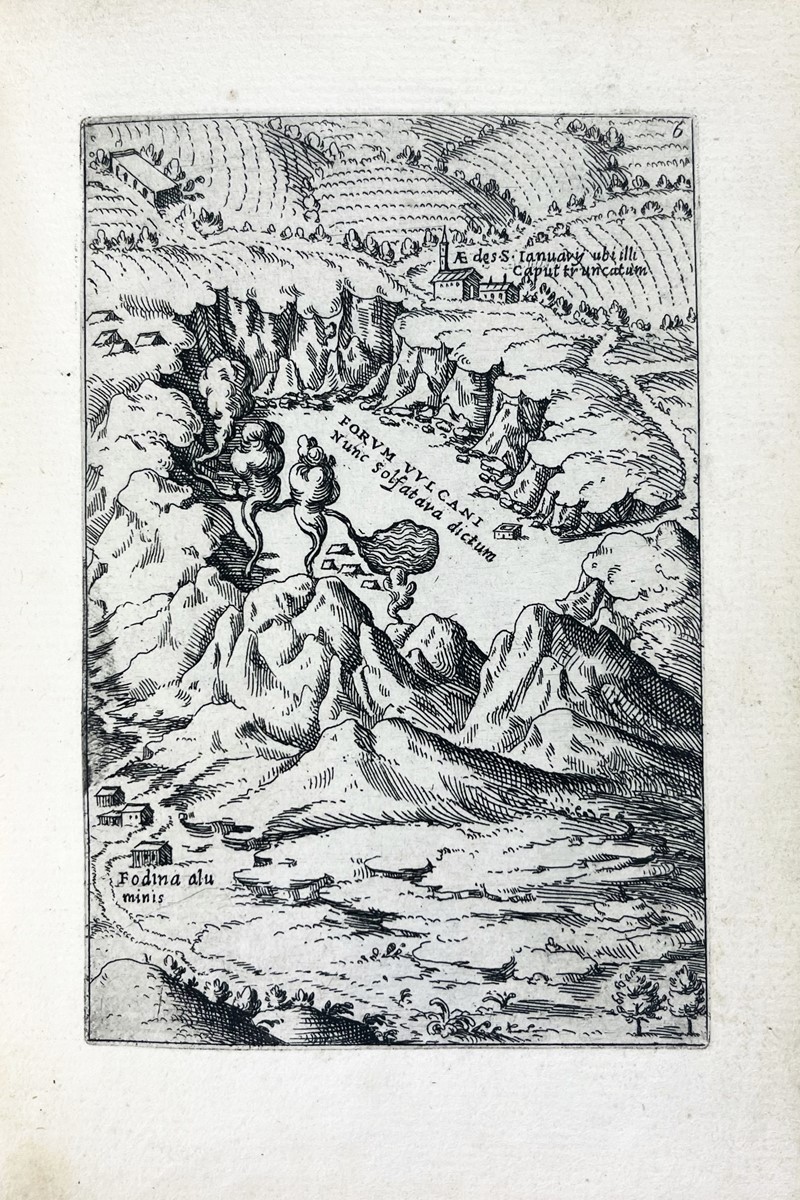
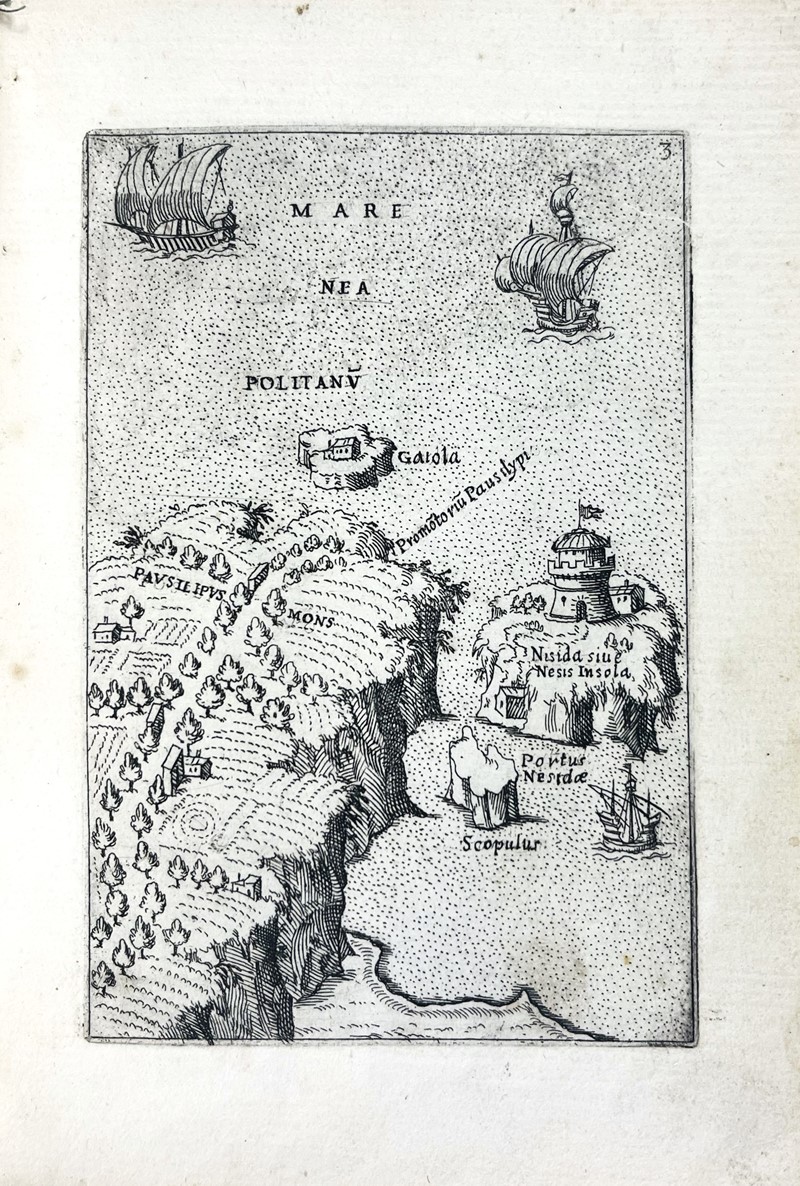
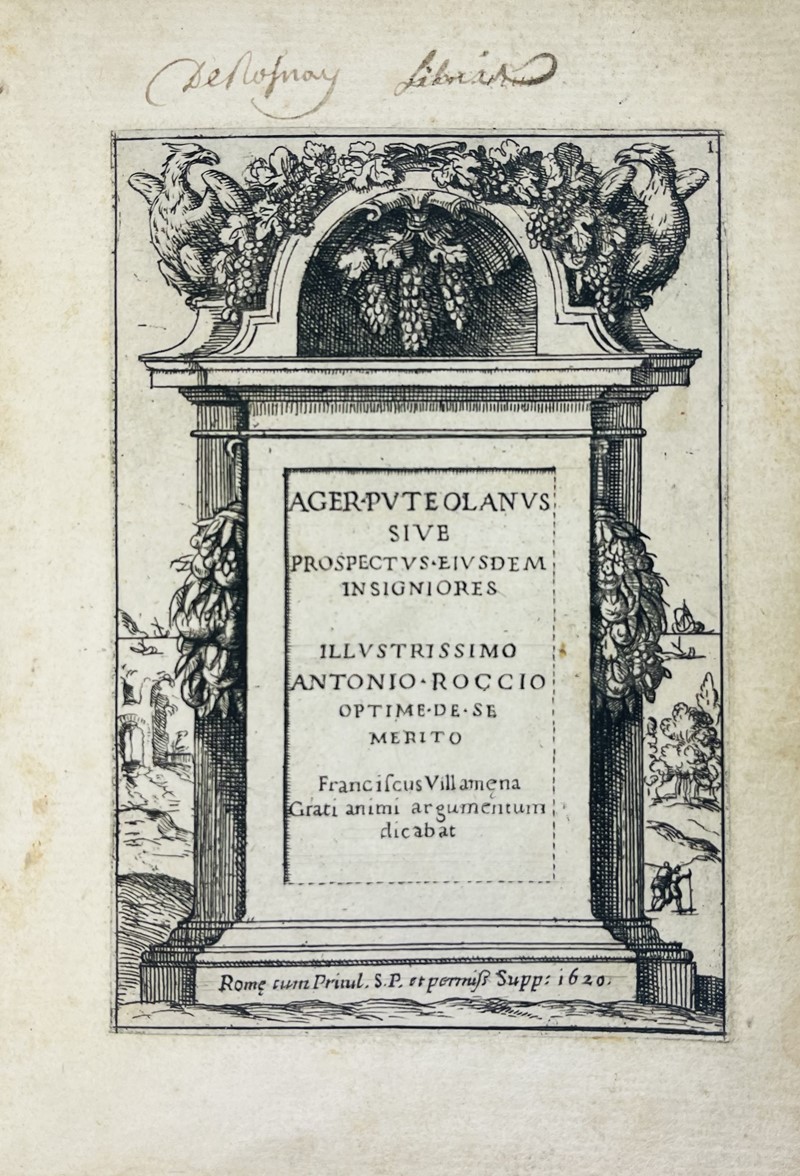
8vo piccolo.174x120 mm. Legatura in piena pelle, fregi e titolo in oro sul dorso a nervi, fogli di guardia in carta marmorizzata policroma. Frontespizio figurato, Avviso al ‘Lettore benevolo’, 22 Tavole, tutto inciso in rame. Nel Frontespizio il titolo continua con “Illustrissimo Antonio Roccio optime de se merito / Franciscus Villamena Grati animi argumentum dicabat”. In totale 24 tavole numerate 1-24. Alcune annotazioni manoscritte antiche. Leggere spellature alla legatura, internamente buon esemplare.
Rarissima Prima edizione. Importantissima fonte iconografica. Le 22 tavole raffigurano zone, litorale e monumenti della cittadina di Pozzuoli e area flegrea. Oltre alle ricostruzioni idealizzate di antichi edifici, ci sono diverse vedute a volo d’uccello del paesaggio in cui sono iscritti importanti monumenti, formazioni geologiche, elementi aneddotici. Tra queste, la celebre Grotta del Cane (tavola n. 5) e informazioni storiche, come la formazione del Monte Nuovo, “in una notte del 1538” (tavola n. 16).
Francesco Villamena, 1564-1624, fu uno dei più importanti incisori del suo tempo. Pittore, disegnatore e incisore, nato ad Assisi, si stabilì in Roma verso il 1590 e divenne scolaro di Lornelis Cort, rimanendo poi nell'orbita stilistica di Agostino Carracci. Svolse una intensa attività incisoria, di cui ci sono pervenuti numerosi saggi, che rivelano nel Villamena un virtuoso del bulino, un tecnico abilissimo, che conosce tutte le possibilità del tratto e degl'incroci di linee, valendosi di un segno netto, vigoroso, pulito, ma spesso piuttosto crudo. Ha inciso composizioni proprie e ha riprodotto opere di Raffaello, Caliari, Barocci, Muziano, Giulio Romano e altri. Ha eseguito inoltre alcuni interessanti frontespizî di libri.
L’editore Gio. Giacomo Rossi ripubblicò l’opera a Roma nel 1652: questa seconda edizione è presente presso l’Istituto Centrale per la Grafica e presso la Biblioteca Hertziana.
Cicognara, 4321; Le Blanc C., Manuel de l'amateur d'estampes, 72, V. 4 p. 125, 1854-59; C.A. Petrucci, Catalogo generale delle stampe tratte dai rami incisi posseduti dalla calcografia nazionale, 1434, p. 126, 1953.
Condition Report
VILLAMENA, Francesco. Ager Puteolanus siue prospectus eiusdem insigniores
Romæ, [s.n.], 1620
Small 8vo. 174x120 mm. Full leather binding, gold decorations and title on the ribbed spine, polychrome marbled paper flyleaves. Illustrated title page, Avviso al ‘Lettore benevolo’, 22 plates, all copper-engraved. On the title page, the title continues: “Illustrious Antonio Roccio, optimum of his merit / Franciscus Villamena, grateful for the arguments he gave.” A total of 24 plates, numbered 1-24. Some ancient handwritten annotations. Some small glazes on binding, internally fine specimen.
Extremely rare first edition. A highly important iconographic source. The 22 plates depict areas, the coastline, and monuments of the town of Pozzuoli and the Phlegraean Fields. In addition to idealized reconstructions of ancient buildings, there are several bird's-eye views of the landscape featuring important monuments, geological formations, and anecdotal elements. These include the famous Antrum Canis (Cave of the Dog, plate no. 5) and historical information, such as the formation of Monte Nuovo "one night in 1538" (plate no. 16).
Francesco Villamena, 1564-1624, was one of the most important engravers of his time. A painter, draftsman, and printmaker born in Assisi, he settled in Rome around 1590 and became a pupil of Lornelis Cort, later remaining in the stylistic orbit of Agostino Carracci. He was an intense engraver, of which numerous excerpts have survived. They reveal Villamena to be a virtuoso with the burin, a highly skilled technician, masterful of all the possibilities of line and intersection, employing a clean, vigorous, and often crude style. He engraved his own compositions and reproduced works by Raphael, Caliari, Barocci, Muziano, Giulio Romano, and others. He also produced some interesting book frontispieces.
The publisher Gio. Giacomo Rossi republished the work in Rome in 1652: this second edition is held by the Istituto Centrale per la Grafica and the Biblioteca Hertziana.
Cicognara, 4321; Le Blanc C., Manuel de l'amateur d'estampes, 72, V. 4 p. 125, 1854-59; C.A. Petrucci, Catalogo generale delle stampe tratte dai rami incisi posseduti dalla calcografia nazionale, 1434, p. 126, 1953.
Bibliografia
Cicognara, 4321; Le Blanc C., Manuel de l'amateur d'estampes, 72, V. 4 p. 125, 1854-59; C.A. Petrucci, Catalogo generale delle stampe tratte dai rami incisi posseduti dalla calcografia nazionale, 1434, p. 126, 1953.
mer 18 Febbraio 2026
Orari Asta
Via dei Soncin, 28 35122 Padova
ESIBIZIONE: 13-16 Febbraio 2026 solo su appuntamento.
Per prenotare il vostro appuntamento chiamare il numero 049 8755317 o mandare una email a info@badoemart.it
Ricordiamo che il nostro staff rimane a vostra disposizione per eseguire condition report dettagliati con foto aggiuntive a quelle già presenti in catalogo.

Bado e Mart
https://www.badoemart.it/img-footer/logo.png
Bado e Mart Srl
Via Dei Soncin, 28
35122 Padova Veneto Italy
Tel. +39 049 8755317
Fax +39 049 8755317
E-mail: info@badoemart.it
Partita IVA IT00773300280
35122 Padova Veneto Italy
Tel. +39 049 8755317
Fax +39 049 8755317
E-mail: info@badoemart.it
Partita IVA IT00773300280
Follow us on
Copyright Bado e Mart 2018. All rights reserved.
Realized by Thetis Srl
Realized by Thetis Srl