Share our site:

SHARE

102
Venice. ALBRIZZI. Forestiere illuminato intorno le cose più rare, e curiose, antiche, e moderne, della città di [..]
1740
EUR 2.000,00
Base d'asta
EUR 3.000,00 / 4.000,00
Stima
Descrizione
Venice. ALBRIZZI. Forestiere illuminato intorno le cose più rare, e curiose, antiche, e moderne, della città di [..]
1740
1740
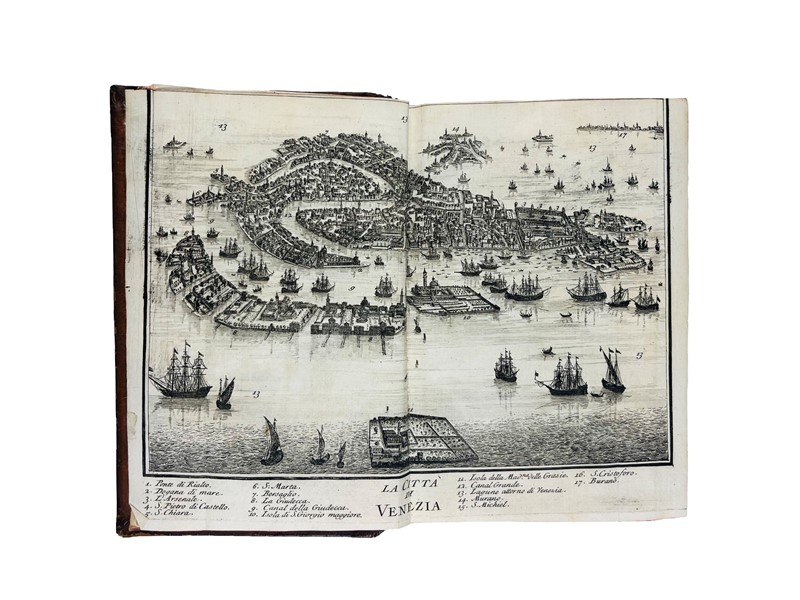
ALBRIZZI, Giovan Battista. Forestiere illuminato intorno le cose più rare, e curiose, antiche, e moderne, della città di Venezia, e dell’isole circonvicine…
Venezia, Giovambatista Albrizzi & Girol., 1740
In 8vo. 160x100 mm. Legatura coeva alle Armi, vitellino nocciola, sui piatti stemma comitale della famiglia Brühl impresso in oro, dorso a 5 nervi con decorazione floreale e titolo in oro, sguardie di carta marmorizzata, tagli rossi. Antiporta incisa in rame, Pagine 16 non numerate, incluso Frontespizio, 343, [9]. Antiporta con lo stemma reale di Polonia, grande veduta generale di Venezia più volte ripiegata, 70 vedute su 42 tavole fuori testo, 25 delle quali su doppia pagina, tutto inciso in rame. Traccia di antico timbro di appartenenza sul margine inferiore del Frontespizio. Bell’esemplare.
Rarissima prima edizione in prima tiratura. Le vedute sono di grande qualità e ricche di dettagli architettonici, molte sono incise da Francesco Zucchi. In antiporta lo stemma di Federigo Cristiano Principe di Polonia sorretto da 3 putti, bella veduta a volo d’uccello di Venezia, e 70 vedute su 42 tavole di cui 25 a doppia pagina. La guida si apre con un’introduzione generale che riguarda Venezia, poi è organizzata in sei percorsi che consentono di visitare sistematicamente l’intera città, e si conclude con la descrizione delle isole della laguna. In questi sei percorsi sono descritti più di 250 siti monumentali e artistici, spesso con annotazioni ricche di preziose informazioni storiche. Morazzoni: “La guida che tutte le altre supera per praticità, copia di notizie e soprattutto per ricchezza di tavole... Albrizzi costituisce un mezzo infallibile per celebrare Venezia”. Le due tirature dell’opera si distinguono per alcune modifiche al testo, come per esempio quella a p. 262 in cui è descritta la chiesa dei Gesuati.
Esemplare di prestigiosa provenienza, appartenuto alla famiglia dei Conti Brühl, originaria della Turingia. La famiglia divenne famosa grazie alla potente ascesa del conte Heinrich von Brühl (1700-1763), che divenne l'uomo più influente del Regno di Sassonia.
Cicogna 4479; Fossati Bellani 2277; Morazzoni p. 230 e 64.
Condition Report
ALBRIZZI, Giovan Battista. Forestiere illuminato intorno le cose più rare, e curiose, antiche, e moderne, della città di Venezia, e dell’isole circonvicine…
Venezia, Giovambatista Albrizzi & Girol., 1740
In 8vo. 160x100 mm. Contemporary Armorial binding, hazelnut calfskin, with the Brühl family coat of arms stamped in gold on the covers, five-ribbed spine with gold floral decoration and title, marbled endpapers, red edges. Copper-engraved frontispiece. 16 unnumbered pages, including the title page, 343, [9]. Frontispiece with the royal coat of arms of Poland, a large, folded general view of Venice, 70 views on 42 plates outside the text, 25 of which are on a double page, all copper-engraved. Trace of an old ownership stamp on the lower margin of the title page. A good copy.
Extremely rare first issue of the first edition. The views are of high quality and rich in architectural detail, many engraved by Francesco Zucchi. The frontispiece features the coat of arms of Frederick Christian, Prince of Poland, supported by three cherubs, a beautiful bird's-eye view of Venice, and 70 views on 42 plates, 25 of which are on double-page. The guide opens with a general introduction about Venice, is then organized into six itineraries that allow for a systematic visit of the entire city, and concludes with a description of the lagoon islands. These six itineraries describe more than 250 monumental and artistic sites, often with annotations rich in valuable historical information. Morazzoni: "This guide surpasses all others in practicality, its wealth of information, and above all, its wealth of plates... Albrizzi is an infallible means of celebrating Venice."
The two editions of the work are distinguished by some changes to the text, such as the one on p. 262 describing the Church of the Gesuati.
This is a copy of prestigious provenance, having belonged to the Counts of Brühl, originally from Thuringia. The family rose to prominence through the powerful rise of Count Heinrich von Brühl (1700–1763), who became the most influential man in the Kingdom of Saxony.
Cicogna 4479; Fossati Bellani 2277; Morazzoni p. 230 e 64.
Bibliografia
Cicogna 4479; Fossati Bellani 2277; Morazzoni p. 230 e 64.
mer 18 Febbraio 2026
Orari Asta
Via dei Soncin, 28 35122 Padova
ESIBIZIONE: 13-16 Febbraio 2026 solo su appuntamento.
Per prenotare il vostro appuntamento chiamare il numero 049 8755317 o mandare una email a info@badoemart.it
Ricordiamo che il nostro staff rimane a vostra disposizione per eseguire condition report dettagliati con foto aggiuntive a quelle già presenti in catalogo.

Bado e Mart
https://www.badoemart.it/img-footer/logo.png
Bado e Mart Srl
Via Dei Soncin, 28
35122 Padova Veneto Italy
Tel. +39 049 8755317
Fax +39 049 8755317
E-mail: info@badoemart.it
Partita IVA IT00773300280
35122 Padova Veneto Italy
Tel. +39 049 8755317
Fax +39 049 8755317
E-mail: info@badoemart.it
Partita IVA IT00773300280
Follow us on
Copyright Bado e Mart 2018. All rights reserved.
Realized by Thetis Srl
Realized by Thetis Srl