Share our site:

SHARE

6
Malta Order - Rhodes. CAOURSIN. Obsidionis Rhodiae urbis descriptio.
1481-83
EUR 7.000,00
Base d'asta
EUR 8.000,00 / 9.000,00
Stima
Descrizione
Malta Order - Rhodes. CAOURSIN. Obsidionis Rhodiae urbis descriptio.
1481-83
1481-83
CAOURSIN, Guillaume. Obsidionis Rhodiae urbis descriptio.
[Rome, Eucharius Silber, 1481 - 1483 circa]
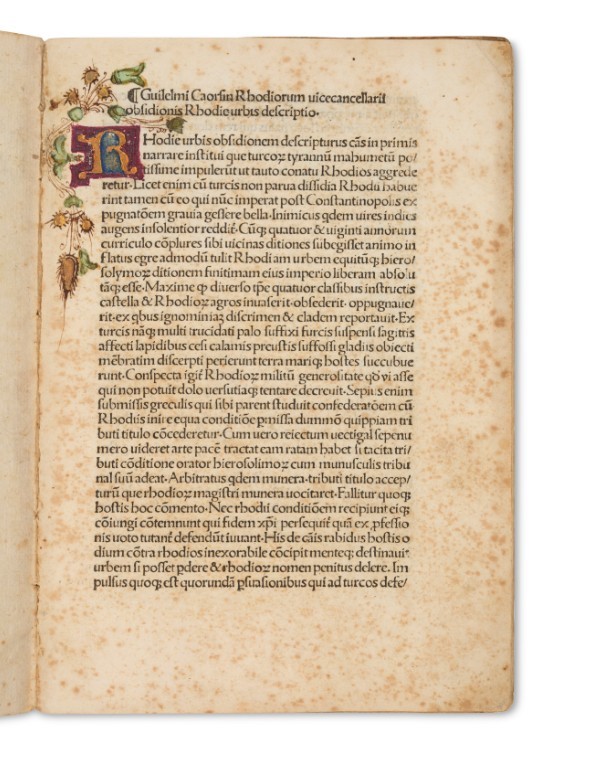
In 4to. 203x143 mm. Legatura in cartonato alla rustica. Carte 12 non numerate. Collazione: [a-b6], 33 righe per pagina. Carattere Romano Antiqua 88 R1. Capolettera miniata in oro, verde, rosso e blu, con estensioni con motivi floreali sul margine. Annotazione manoscritta in italiano di mano ottocentesca nel primo foglio di guardia. Nel piatto superiore iscrizione antica in inchiostro nero “Corsin Guglielmo / L’Assedio di Rodi”. Ex libris “Bonchristiano” incollato al contropiatto. Lievi fioriture alle prime e ultime carte.
Rarissima edizione, la prima impressa a Roma. Documento di prima mano che descrive l’assedio dei Turchi dell’Isola di Rodi, valorosamente difesa dai Cavalieri Ospitalieri nel 1480. L’opera è scritta da un testimone oculare degli eventi, il Vicecancelliere dell'Ordine Ospedaliero, che descrive accuratamente gli eventi. Nel maggio del 1480, le galee turche al comando del sultano Mohamet (Mehmet) assediarono l'isola di Rodi, sede dell'Ordine di San Giovanni. Quarantamila turchi tentarono di conquistarla. L'assedio durò tre mesi e alla fine l'esercito ottomano fu sconfitto, nonostante la superiorità numerica, dall'Ordine di San Giovanni in difficoltà. La tradizione vuole che nell'ultima battaglia la vittoria non fosse a favore di nessuno dei due schieramenti che combatterono coraggiosamente. Il cielo si aprì e le figure della Beata Vergine Maria e di San Giovanni Battista, Patrono dell'Ordine, incussero tale terrore ai Turchi che le truppe cristiane li misero in fuga e riuscirono a ottenere la vittoria desiderata.
Il francese Guglielmo di Cauorsin, c. 1430-1501, Vice Cancelliere dell'Ordine di San Giovanni, fu uno dei cavalieri che combatterono nell'assedio di Rodi. La difesa vittoriosa rafforzò il prestigio dell'Ordine e utilizzò la nuova tecnologia della stampa a fini propagandistici, secondo il Museo dell'Ordine di San Giovanni. La ‘Descriptio’ non solo alimentò la fame di notizie dell'Europa occidentale su un'importante vittoria cristiana nella guerra in corso con i turchi, ma contribuì anche a plasmare la percezione pubblica degli Ospitalieri. Caoursin scrisse in uno stile umanistico, sacrificando la terminologia militare per rivolgersi a un pubblico colto; nel giro di pochi anni, tuttavia, il suo testo latino divenne la base per versioni in volgare, anch'esse ampiamente diffuse. Gli storici moderni riconoscono il contributo che l'assedio ottomano di Rodi nel 1480 diede allo sviluppo della tecnologia militare, in particolare alla scienza delle fortificazioni
Alla carta b5 verso si parla della miracolosa apparizione celeste della Madonna e di San Giovanni Battista che mutò le sorti della battaglia.
Opera appartenuta ad Antônio Bonchristiano, importante collezionista di libri antichi rari e di valore, con una biblioteca privata a San Paolo, in Brasile.
HC 4358; IGI 2420; BMC IV,119; GW 6009; Goff C110; Bod-inc C-051. Appena 7 copie registrate da ISTC, tre delle quali in Italia.
Condition Report
CAOURSIN, Guillaume. Obsidionis Rhodiae urbis descriptio.
[Rome, Eucharius Silber, 1481. – 1483 circa]
4to. 203 x 143 mm. Sewing binding. 12 unnumbered leaves. Collation: [a-b6], 33 lines per page. Romano Antiqua 88 R1 type. Illuminated initial in gold, green, red and blue, with extensions with floral motifs in the margin. Handwritten annotation in Italian in a 19th-century hand on the first flyleaf. On the upper cover, an ancient inscription in black ink “Corsin Guglielmo / L’Assedio di Rodi”. Ex libris “Bonchristiano” glued to the inside cover. Slight foxing on the first and last leaves.
Extremely rare edition, the first printed in Rome. A first-hand document describing the Turkish siege of the island of Rhodes, valiantly defended by the Knights Hospitaller in 1480. The work is written by an eyewitness to the events, the Vice-Chancellor of the Hospitaller Order, who accurately describes them. In May 1480, Turkish galleys under the command of Sultan Mohammed (Mehmet) besieged the island of Rhodes, home of the Order of Saint John. Forty thousand Turks attempted to conquer it. The siege lasted three months, and the Ottoman army was ultimately defeated, despite its numerical superiority, by the hard-pressed Order of Saint John. Tradition holds that in the final battle, victory was not in favor of either side, who fought bravely. The heavens opened, and the figures of the Blessed Virgin Mary and Saint John the Baptist, patron saint of the Order, struck such terror into the Turks that the Christian troops routed them and achieved their desired victory.
The Frenchman William of Cauorsin, c. 1430–1501, Vice-Chancellor of the Order of Saint John, was one of the knights who fought in the siege of Rhodes. The victorious defense strengthened the Order's prestige and used the new technology of printing for propaganda purposes, according to the Museum of the Order of Saint John. The "Descriptio" not only fueled Western Europe's hunger for news of a major Christian victory in the ongoing war with the Turks, but also helped shape public perception of the Hospitallers. Caoursin wrote in a humanistic style, sacrificing military terminology to appeal to a cultured audience; within a few years, however, his Latin text became the basis for vernacular versions, which also became widely circulated. Modern historians recognize the contribution that the Ottoman siege of Rhodes in 1480 made to the development of military technology, particularly the science of fortifications.
On folio b5 verso, the miraculous heavenly apparition of the Madonna and Saint John the Baptist that turned the tide of the battle is mentioned.
Copy owned by Antônio Bonchristiano, an prominet collector of rare and valuable ancient books, with a private library in São Paulo, Brazil.
HC 4358; IGI 2420; BMC IV,119; GW 6009; Goff C110; Bod-inc C-051. Only 7 copies registered by ISTC, three of which are in Italy.
Bibliografia
HC 4358; IGI 2420; BMC IV,119; GW 6009; Goff C110; Bod-inc C-051. Appena 7 copie registrate da ISTC, tre delle quali in Italia.
mer 18 Febbraio 2026
Orari Asta
Via dei Soncin, 28 35122 Padova
ESIBIZIONE: 13-16 Febbraio 2026 solo su appuntamento.
Per prenotare il vostro appuntamento chiamare il numero 049 8755317 o mandare una email a info@badoemart.it
Ricordiamo che il nostro staff rimane a vostra disposizione per eseguire condition report dettagliati con foto aggiuntive a quelle già presenti in catalogo.

Bado e Mart
https://www.badoemart.it/img-footer/logo.png
Bado e Mart Srl
Via Dei Soncin, 28
35122 Padova Veneto Italy
Tel. +39 049 8755317
Fax +39 049 8755317
E-mail: info@badoemart.it
Partita IVA IT00773300280
35122 Padova Veneto Italy
Tel. +39 049 8755317
Fax +39 049 8755317
E-mail: info@badoemart.it
Partita IVA IT00773300280
Follow us on
Copyright Bado e Mart 2018. All rights reserved.
Realized by Thetis Srl
Realized by Thetis Srl