Share our site:

SHARE
2
LACTANTIUS. De diuinis institutionibus aduersus gentes.
1490
EUR 3.500,00
Base d'asta
EUR 5.000,00 / 6.000,00
Stima
Descrizione
LACTANTIUS. De diuinis institutionibus aduersus gentes.
1490
1490
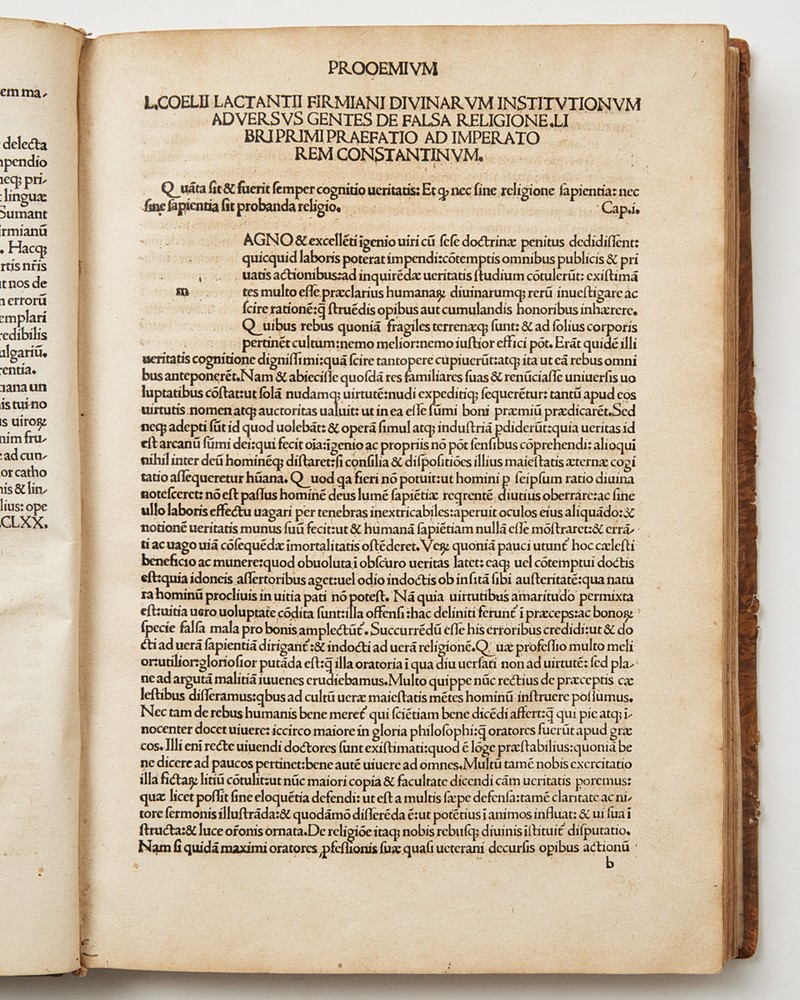
LACTANTIUS, Lucius Coelius Firmianus. De diuinis institutionibus aduersus gentes: Rubricae primi lbri incipiunt.
Venetiis, Theodorus de Ragazonibus, 1490
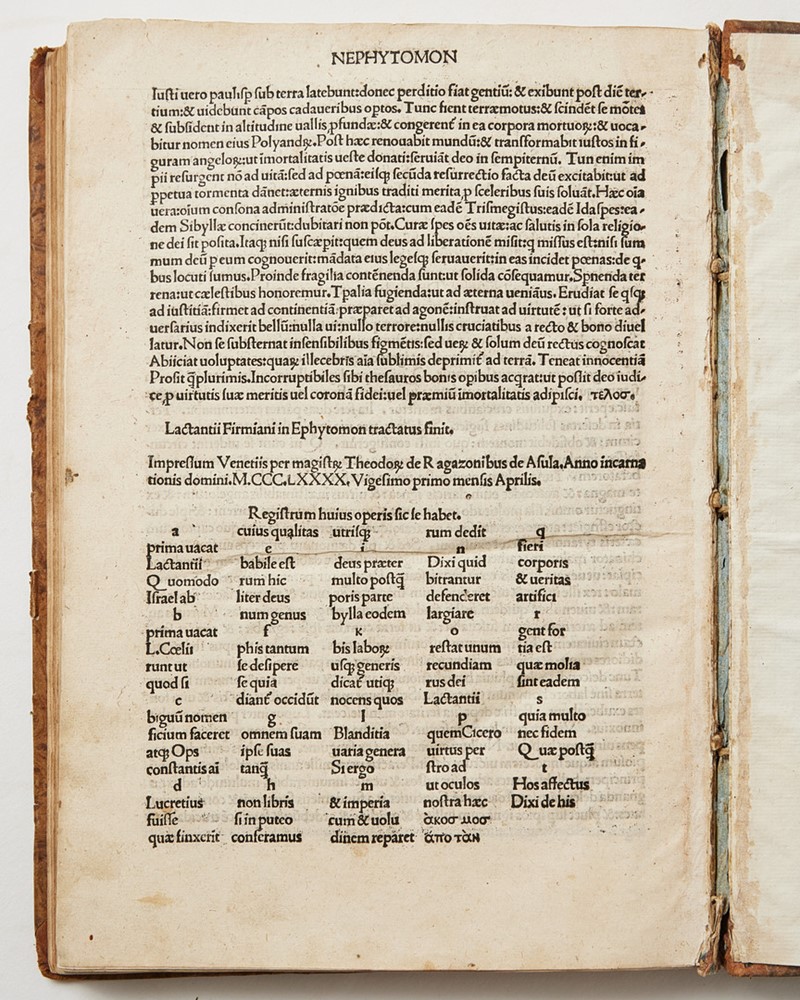
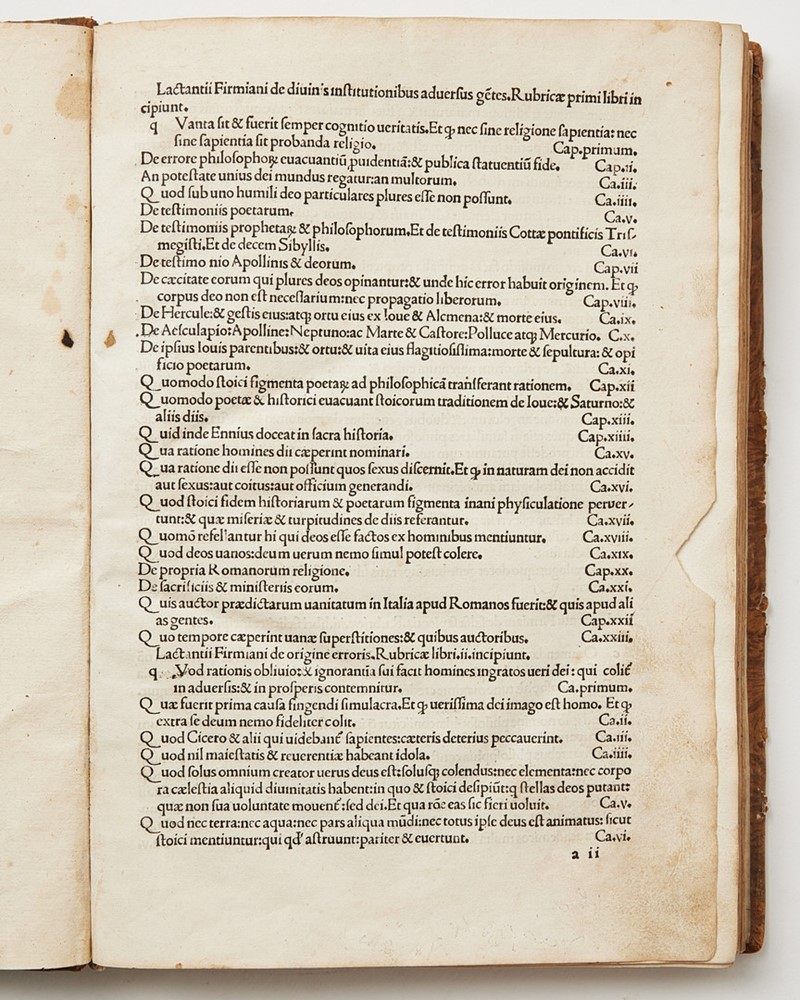
Folio. Legatura circa 300x215 mm, fogli 295x200 mm. Legatura del XVIII pelle, mezza pelle marrone e cartonato marmorizzato, titolo e fregi in oro al dorso, sguardie rinnovate. Carte [148], compresa la prima carta bianca, 45 righe e titolo, caratteri romani e alcuni greci, spazi iniziali con letterine guida. Colophon in fine: “Impressum Venetiis per magistrum Theodorum de Ragazonibus de Asula, M.CCC.LXXXX. [i.e. 1490] Vigesimo primo mensis Aprilis.” Marginalia a inchiostro, di mano antica. Prima pagina bianca leggermente macchiata, foglio aii con strappo al margine esterno. Buon esemplare.
Raro e prezioso incunabolo delle opere di Lattanzio. L’edizione, curata dal vescovo umanista Giovanni Andrea Bussi (1417-1475), comprende i sette libri del De divinis institutionibus, primo tentativo di sintesi dell’insegnamento cristiano, seguiti dal De ira Dei, dal De opificio Dei, dal poemetto in esametri De Phoenice carmina (con citazioni di brani sulla fenice tratti dalle Metamorfosi di Ovidio e dall’Inferno di Dante, canto XXIV, 106-111), dal De resurrectionis dominicae die, ed infine dal Nephythomon, compendio delle Institutionibus. Contiene anche Venanzio Fortunato, Carmen de Pascha.
Si tratta della seconda edizione a cura di Giovanni d'Andrea vescovo di Aleria il cui nome appare a c. [9]v e decima edizione complessiva.
Lattanzio (250-325 circa), uno dei primi autori cristiani, divenne consigliere dell'imperatore romano Costantino I e tutore di suo figlio Crispo; per il suo stile elegante e il periodare articolato si guadagnò il soprannome di ‘Cicerone cristiano’ da parte degli eruditi del Rinascimento.
BMC V, p. 477; Hain-Copinger 9815; Goff L,10; GKW M 16563.
Condition Report
LACTANTIUS, Lucius Coelius Firmianus. De diuinis institutionibus aduersus gentes: Rubricae primi lbri incipiunt.
Venetiis, Theodorus de Ragazonibus, 1490
Folio. 300x215 mm, 18th-century leather, brown quarter leather, and marbled cardboard, gilt title and decorations on the spine, renewed flyleaves. 148 unnumbered leaves, including the first blank leaf, 45 lines and title, Roman and some Greek type, initial spaces with guide letters. Colophon at the end: “Impressum Venetiis per magistrum Theodorum de Ragazonibus de Asula, M.CCC.LXXXX. [i.e. 1490] Vigesimo primo mensis Aprilis.” Ink marginalia, by an old hand. First page slightly stained, folio aii with tear in the outer margin. Overall a good copy.
A rare and precious incunabulum of the works of Lactantius. The volume, edited by the humanist bishop Giovanni Andrea Bussi (1417-1475), includes the seven books of De divinis institutionibus, the first attempt to summarize Christian teaching, followed by De ira Dei, De opificio Dei, the hexameter poem De Phoenice carmina (with quotations from passages on the phoenix from Ovid's Metamorphoses and Dante's Inferno, canto XXIV, 106-111), De resurrectionis dominicae die, and finally the Nephythomon, a compendium of the Institutionibus. It also contains Venantius Fortunatus, Carmen de Pascha.
This is the second edition edited by Giovanni d'Andrea, bishop of Aleria, whose name appears on fol. [9]v, and the tenth edition overall.
Lactantius (c. 250–325), one of the first Christian authors, became an advisor to the Roman Emperor Constantine I and tutor to his son Crispus; his elegant style and detailed sentences earned him the nickname ‘Christian Cicero’ from Renaissance scholars.
BMC V, p. 477; Hain-Copinger 9815; Goff L,10; GKW M 16563.
Bibliografia
BMC V, p. 477; Hain-Copinger 9815; Goff L,10; GKW M 16563.
mer 18 Febbraio 2026
Orari Asta
Via dei Soncin, 28 35122 Padova
ESIBIZIONE: 13-16 Febbraio 2026 solo su appuntamento.
Per prenotare il vostro appuntamento chiamare il numero 049 8755317 o mandare una email a info@badoemart.it
Ricordiamo che il nostro staff rimane a vostra disposizione per eseguire condition report dettagliati con foto aggiuntive a quelle già presenti in catalogo.

Bado e Mart
https://www.badoemart.it/img-footer/logo.png
Bado e Mart Srl
Via Dei Soncin, 28
35122 Padova Veneto Italy
Tel. +39 049 8755317
Fax +39 049 8755317
E-mail: info@badoemart.it
Partita IVA IT00773300280
35122 Padova Veneto Italy
Tel. +39 049 8755317
Fax +39 049 8755317
E-mail: info@badoemart.it
Partita IVA IT00773300280
Follow us on
Copyright Bado e Mart 2018. All rights reserved.
Realized by Thetis Srl
Realized by Thetis Srl