Share our site:

SHARE
1
ROLEWINCK. Fasciculus temporum.
1483
EUR 8.500,00
Base d'asta
EUR 10.000,00 / 12.000,00
Stima
Descrizione
ROLEWINCK. Fasciculus temporum.
1483
1483
ROLEWINCK, Werner. Fasciculus temporum.
Köln, Ludwig von Renchen, non dopo il 1483
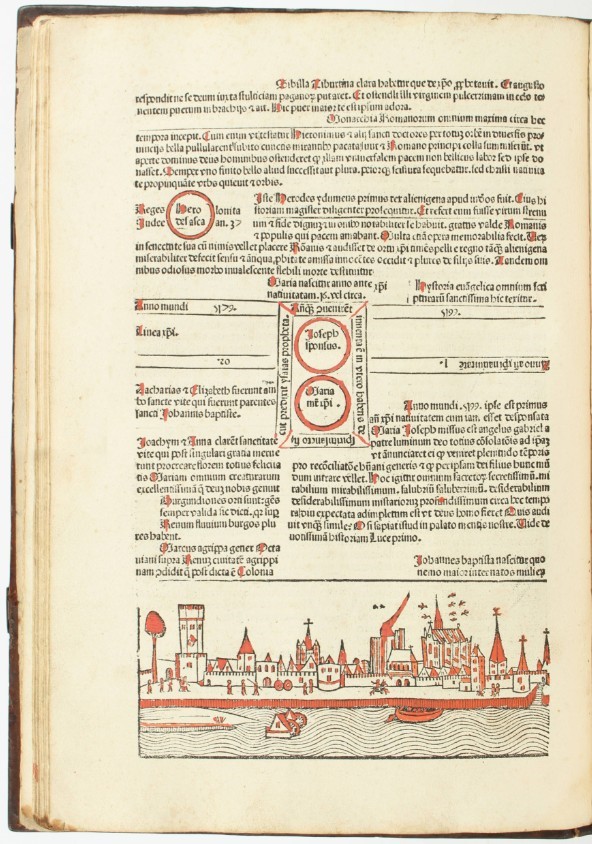
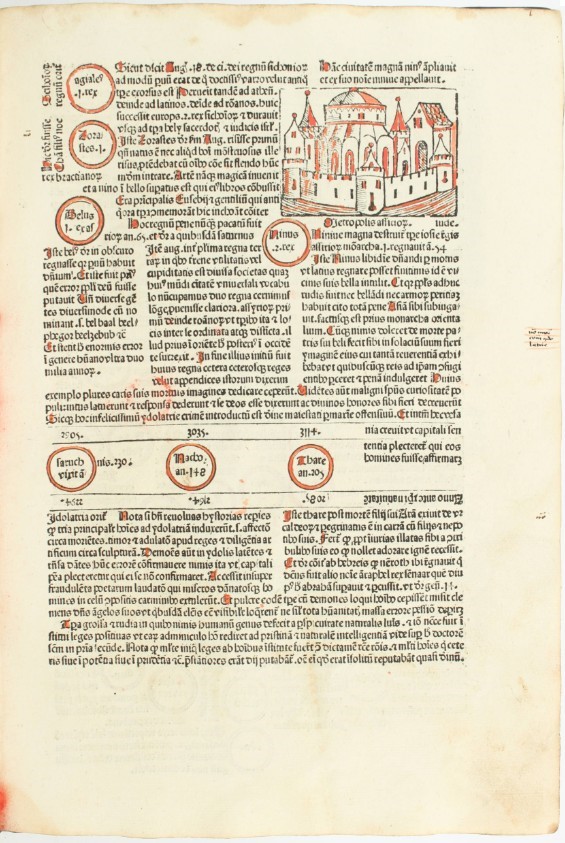
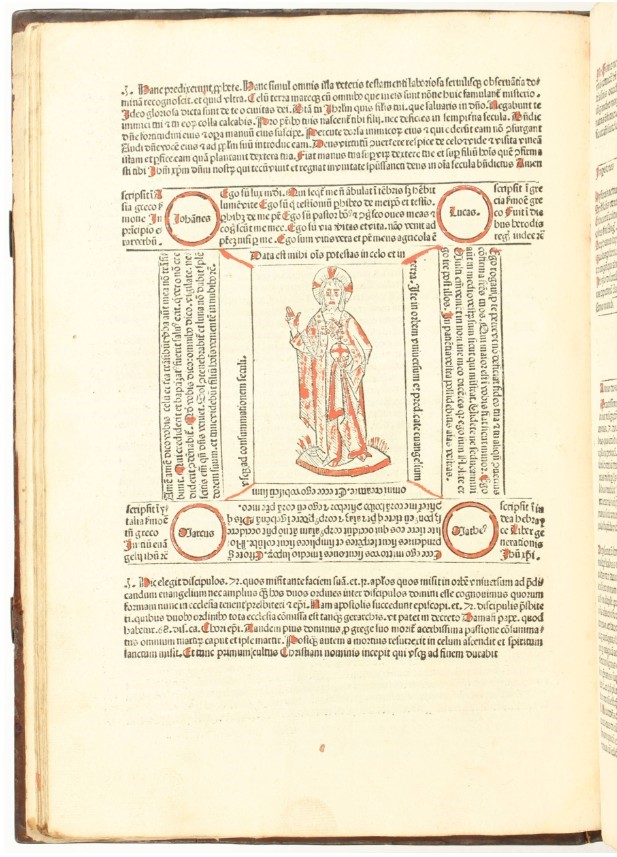
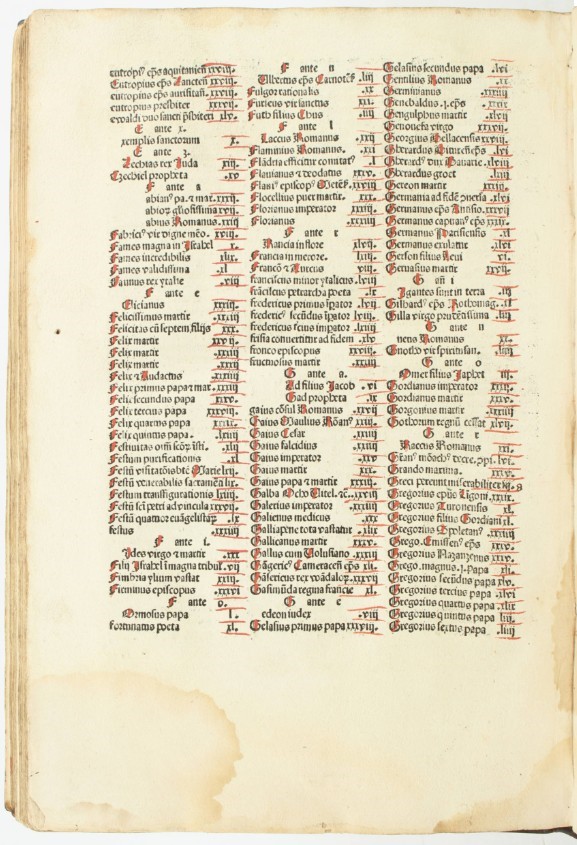
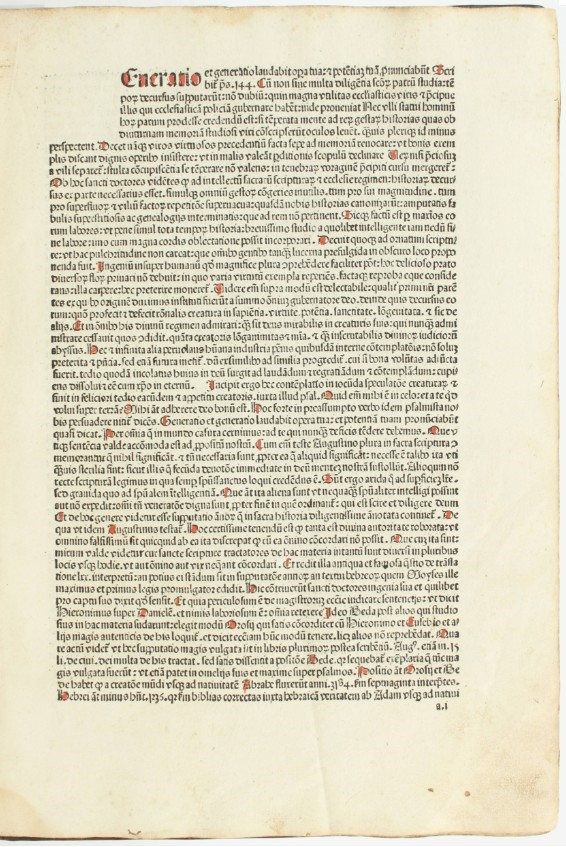
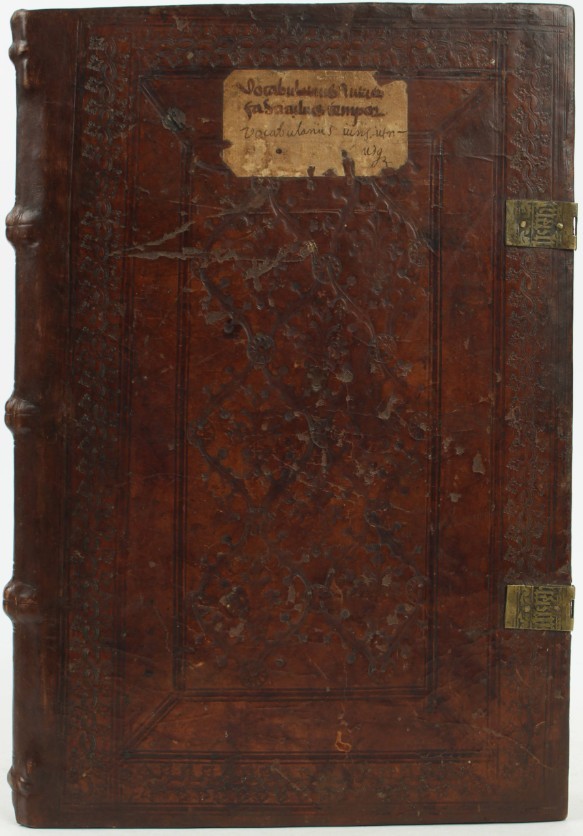
Folio. 315x210 mm. Legatura coeva in pelle con impressioni a secco su assi di legno, restaurata, dorso rinnovato, senza fermagli. 74 carte non numerate (la prima bianca). Segnatura: a-b8, c6, d8, e6, f8, g6, h8, i8, a8. Le ultime 8 carte, a8, contengono la ‘Tabula brevis’. Testo su tre colonne di 53 righe, spazi per le Iniziali, carattere gotico. Con 10 xilografie (1 ripetuta) e numerosi diagrammi a forma di cerchio, tutti colorati in rosso. Carattere gotico. Rubricato su tutto il testo. Marginalia di mano coeva su tutto il testo, in rosso e nero. Alcune macchie d'acqua marginali, più evidenti alla fine; fori di tarlo marginali in alcuni punti, piccolo strappo marginale su una carta. Bell’esemplare con ampi margini, rubricato su tutto il testo.
Rarissima edizione. Il Fasciculus temporum, pubblicato la prima volta a Colonia nel 1474, è stata la prima cronaca del mondo stampata e si proponeva di offrire ai lettori una panoramica completa della storia dell’umanità, dalla Creazione al 1474: la cronologia segue una doppia linea temporale, misurando il tempo sia dalla creazione che dalla nascita di Cristo, richiedendo un layout tipografico straordinariamente complesso. Relativamente a questa edizione BMC nota: “With woodcuts: the cut of Cologne n Quentell’s 1481 eddition recurs here, broken at one end. Guendenschaff’s cut of the Crucifixion also recurs,. The attribution of this book is uncertain … The supplement on 66a consists of a detailed account of the meeting of Charles Duke of Burgundy with the Emperor Frederidh an his son Maximilian at Trier in 1473 …” Fra le xilografie compaiono: L’Arca di Noè, La Torre di Babele, vedute di città fra cui Roma e Colonia.
Nella penultima carta di testo, i7v, è menzionata anche l’invenzione della stampa, a Magonza: “1457 … Artifices mira celeritate subtiliores solito fiunt. Et impressores librorum multiplicantur in terra, ortum suae habentes in Maguntia.”
L'opera fu immensamente popolare, essendo stata stampata 32 volte nel XV secolo, comprese le traduzioni in francese, tedesco e olandese.
L'attribuzione della stampa a Ludwig von Renchen è incerta.
Hain-C. 6914; GW M38689; BMC I, 269; Goff R-269; Voulliéme, Colonia 1033; Schramm VIII, p. 25 e tavola 138.
Condition Report
ROLEWINCK, Werner. Fasciculus temporum.
Köln, Ludwig von Renchen, not after 1483
Folio. 315x210 mm. Contemporary leather binding with blind-tooled wooden boards, restored, spine renewed, no clasps. 74 unnumbered pages (the first blank). Collation: a-b8, c6, d8, e6, f8, g6, h8, i8, a8. The last 8 leaves, a8, contain the “Tabula brevis”. Text in three columns of 53 lines, spaces for initials, Gothic type. With 10 woodcuts (1 repeated) and numerous circular diagrams, all coloured in red. Gothic type. Rubricated throughout the text. Contemporary marginalia throughout the text, in red and black. Some marginal water stains, more evident at the end; marginal wormholes in some places, small marginal tear on one leaf. A fine copy with wide margins, rubricated throughout the text.
Extremely rare edition. The Fasciculus temporum, first published in Cologne in 1474, was the world's first printed chronicle and aimed to offer readers a comprehensive overview of human history, from Creation to 1474: the chronology follows a dual timeline, measuring time from both Creation and the birth of Christ, requiring an extraordinarily complex typographical layout. Regarding this edition, BMC notes: 'With woodcuts: the cut of Cologne n Quentell's 1481 edition recurs here, broken at one end. Guendenschaff's cut of the Crucifixion also recurs. The attribution of this book is uncertain ... The supplement on 66a consists of a detailed account of the meeting of Charles Duke of Burgundy with Emperor Frederidh and his son Maximilian at Trier in 1473 ..." Among the woodcuts are: Noah's Ark, The Tower of Babel, views of cities including Rome and Cologne.
The penultimate page of text, i7v, also mentions the invention of printing in Mainz: ‘1457 ... Artifices mira celeritate subtiliores solito fiunt. Et impressores librorum multiplicantur in terra, ortum suae habentes in Maguntia.’
The work was immensely popular, having been printed 32 times in the 15th century, including translations into French, German and Dutch.
Hain-C. 6914; GW M38689; BMC I, 269; Goff R-269; Voulliéme, Colonia 1033; Schramm VIII, p. 25 e tavola 138.
Bibliografia
Hain-C. 6914; GW M38689; BMC I, 269; Goff R-269; Voulliéme, Colonia 1033; Schramm VIII, p. 25 e tavola 138.
mer 18 Febbraio 2026
Orari Asta
Via dei Soncin, 28 35122 Padova
ESIBIZIONE: 13-16 Febbraio 2026 solo su appuntamento.
Per prenotare il vostro appuntamento chiamare il numero 049 8755317 o mandare una email a info@badoemart.it
Ricordiamo che il nostro staff rimane a vostra disposizione per eseguire condition report dettagliati con foto aggiuntive a quelle già presenti in catalogo.

Bado e Mart
https://www.badoemart.it/img-footer/logo.png
Bado e Mart Srl
Via Dei Soncin, 28
35122 Padova Veneto Italy
Tel. +39 049 8755317
Fax +39 049 8755317
E-mail: info@badoemart.it
Partita IVA IT00773300280
35122 Padova Veneto Italy
Tel. +39 049 8755317
Fax +39 049 8755317
E-mail: info@badoemart.it
Partita IVA IT00773300280
Follow us on
Copyright Bado e Mart 2018. All rights reserved.
Realized by Thetis Srl
Realized by Thetis Srl