Share our site:

SHARE
129
BAIF-RUTILIUS LUPUS-GUIDOBALDUS-AGRICOLA. Four rare works from the first half of the 16th century.
EUR 400,00
Base d'asta
EUR 600,00 / 800,00
Stima
Descrizione
BAIF-RUTILIUS LUPUS-GUIDOBALDUS-AGRICOLA. Four rare works from the first half of the 16th century.
BAIF, Lazare; de. Opus de re uestimentaria… Eiusdem, de uasculorum materiis ac uarietate tractatus, antehac nunquam excusus.
Venezia, Melchiorre Sessa, 1535
Carte 72, [8]. Colophon a carta K7r “Venetiis per Ioan. Anto. de Nicolinis de Sabio. Sumptu vero & requisitione D. Melchioris Sessae, Anno Diii. M D XXXV. Mense Septemb.” Marca tipografica al Frontespizio e alla carta K8. Iniziali ‘GF’ manoscritte sul Frontespizio, inchiostro seppia; altra nota manoscritta di possesso non leggibile. Frontespizio rinforzato al verso.
Legato con:
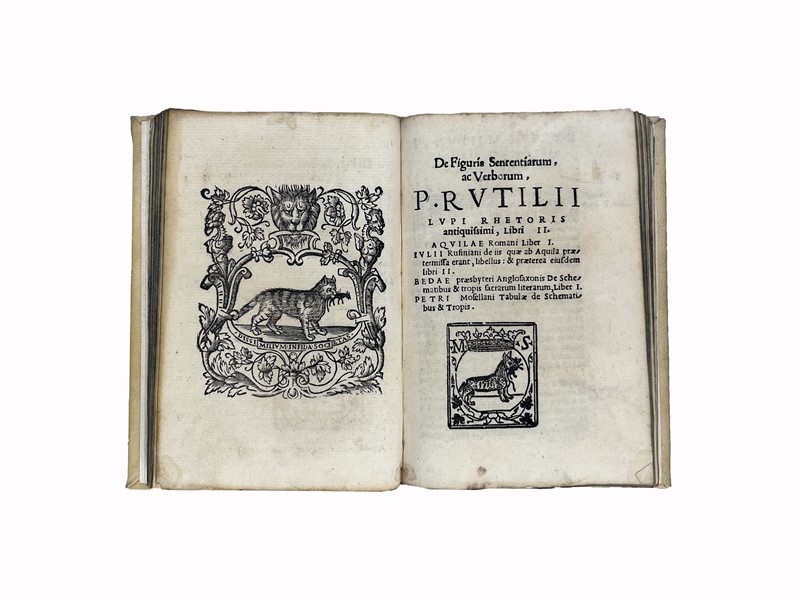
RUTILIUS LUPUS, Publius. De figuris sententiarum ac verborum.
Venezia, Melchiorre Sessa, 1533
Carte 60, [4]. Carta H7 bianca. Colophon a carta H6v “Venetiis per Io. Antonium & fratres de Sabio Sumptu & requisitione D. Melchioris Sessæ. Anno Domini M D XXXV III.” Marca tipografica al Frontespizio e alla carta H8v.
Legato con:
GUIDOBALDUS, Gulielmus. Contra Antonium Galfredum Condriceum Ethruscae Academiae obtrectatorem … Apologia.
Senza luogo né data [Lione, prima metà XVI secolo]
Carte [7], 1 bianca.
Legato con:
AGRICOLA, Rudolf. De ratione studii epistola Rodolphi Agricolae. Phil. Mel. ad formanda studia, corrigendaque...
Norimberga, Johann Petreius, 1530
Carte [11], 1 bianca. Iniziali xilografiche, carattere italico.
Quattro rare opere della prima metà del XVI secolo.
1. Baif. Il De Vestimentaria è un importante trattato secolo sull'abbigliamento e i costumi delle civiltà antiche. De Baif era un erudito umanista che si interessò allo sviluppo della moda in varie culture. Tra le civiltà più importanti prese in esame figurano Babilonia e Corinto, con discussioni sul colore e i disegni di toghe, tuniche e molto altro. Quest'opera, che rappresenta il primo trattato monografico sull'argomento, riscosse immediato successo e fu rapidamente ristampata dai più prestigiosi editori europei: divenne infine il punto di riferimento per tutti i trattati sull'argomento che seguirono.
2. Il "De figuris sententiarum", trattato di retorica del letterato romano Publio Rutilio Lupo, del I secolo d.C., è originariamente un compendio del "peri schêmatôn", opera dell'oratore greco Gorgia di Atene, da non confondere con il celebre Gorgia di Leontini, contemporaneo di Socrate. Questo Gorgia di Atene è anche noto come il retore che insegnò a Marco, figlio di Cicerone, ad Atene nel 44 a.C. (Cic. Fam. 16,21,6). Il valore principale del trattato risiede nelle numerose traduzioni di estratti e di passaggi significativi degli oratori greci, che preservano così gran parte di ciò che altrimenti andrebbe perduto. Già nell'edizione princeps del 1519 fu stampato insieme al "De figuris" di Aquila Romanus.
3. Rarissima edizione. Importante opera polemica del medico francese. Esposizione della dottrina di Galeno con riferimento a uno dei più influenti medici dell’epoca, Symphorien Champier, citato con il nome latino ‘Campetus’. L’autore nel titolo si dichiara ‘Bellovacensis’, ossia originario di Beauvais.
Cfr. Hamon, Marie-Josepe. D’Hippocrate a Symphorien Champier: les medecins et l’edition lyonnaise au XVIe siecle, 1978.
In: https://www.enssib.fr/bibliotheque-numerique/documents/63873-hippocrate-a-symphorien-champier-les-medecins-et-l-edition-lyonnaise-au-xvie-siecle-d.pdf
4. Influente opera pedagogica umanistica del 1530 del dotto olandese Rudolf Agricola (1443-1485). Il testo fornisce un metodo strutturato per lo studio della letteratura, sottolineando il legame profondo tra linguaggio, logica e formazione morale dell'individuo. L'opera di Agricola, spesso pubblicata come ‘epistola’, propone un metodo pratico per l'educazione. Si concentra sull'apprendimento delle lingue classiche (latino e greco) non solo come strumenti grammaticali, ma come mezzo per accedere alla saggezza antica e formare il pensiero critico.
4 opere in un volume in-8vo. 150x95 mm. Legatura in pergamena rigida, titolo in oro sul dorso, fogli di guardia rinnovati, tagli blu indaco. Frontespizio rinforzato.
Condition Report
BAIF, Lazare; de. Opus de re uestimentaria… Eiusdem, de uasculorum materiis ac uarietate tractatus, antehac nunquam excusus.
Venice, Melchiorre Sessa, 1535
72 leaves, [8]. Colophon on leaf K7r: “Venetiis per Ioan. Anto. de Nicolinis de Sabio. At the expense and request of D. Melchior Sessa, in the year 1535, in the month of September.” Printer’s device on the title page and on leaf K8. Initials ‘GF’ handwritten on the title page in sepia ink; another illegible handwritten ownership note. Title page reinforced on the reverse.
Bound with:
RUTILIUS LUPUS, Publius. De figuris sententiarum ac verborum.
Venice, Melchiorre Sessa, 1533
60 leaves, [4]. Leaf H7 blank. Colophon on leaf H6v: “Venetiis per Io. Antonium & fratres de Sabio Sumptu & requisitione D. Melchioris Sessæ. Anno Domini M D XXXV III.” Printer’s device on the title page and on leaf H8v.
Bound with:
GUIDOBALDUS, Gulielmus. Contra Antonium Galfredum Condriceum, slanderer of the Etruscan Academy … Apologia.
No place or date [Lyon, first half of the 16th century]
7 leaves, 1 blank.
Bound with:
AGRICOLA, Rudolf. De ratione studii epistola Rodolphi Agricolae. Phil. Mel. ad formanda studia, corrigendaque...
Nuremberg, Johann Petreius, 1530
Leaves [11], 1 blank. Woodcut initials, italic type.
Four rare works from the first half of the 16th century.
1. Baif. "De Vestimentaria" is an important 16th-century treatise on the clothing and customs of ancient civilisations. Baif was a learned humanist who took an interest in the development of fashion across various cultures. Among the most significant civilisations examined are Babylon and Corinth, with discussions on the colours and designs of togas, tunics and much more. This work, which represents the first monographic treatise on the subject, enjoyed immediate success and was quickly reprinted by the most prestigious European publishers: it eventually became the benchmark for all subsequent treatises on the subject.
2. The ‘De figuris sententiarum’, a treatise on rhetoric by the 1st-century AD Roman scholar Publius Rutilius Lupus, is originally a compendium of the ‘Peri schêmatôn’, a work by the Greek orator Gorgias of Athens, not to be confused with the famous Gorgias of Leontini, a contemporary of Socrates. This Gorgias of Athens is also known as the rhetorician who taught Marcus, son of Cicero, in Athens in 44 BC (Cic. Fam. 16.21.6). The main value of the treatise lies in the numerous translations of extracts and significant passages from Greek orators, which thus preserve much of what would otherwise have been lost. It was already printed together with Aquila Romanus’s “De figuris” in the first edition of 1519.
3. An extremely rare edition. An important polemical work by the French physician. An exposition of Galen’s doctrine with reference to one of the most influential physicians of the time, Symphorien Champier, cited by his Latin name ‘Campetus’. In the title, the author identifies himself as ‘Bellovacensis’, that is, a native of Beauvais.
See Hamon, Marie-Josepe. From Hippocrates to Symphorien Champier: Doctors and the Lyon Press in the 16th Century, 1978.
In: https://www.enssib.fr/bibliotheque-numerique/documents/63873-hippocrate-a-symphorien-champier-les-medecins-et-l-edition-lyonnaise-au-xvie-siecle-d.pdf
4. An influential humanist educational work from 1530 by the learned Dutch scholar Rudolf Agricola (1443–1485). The text provides a structured method for the study of literature, emphasising the profound link between language, logic and the moral formation of the individual. Agricola’s work, often published as an ‘epistle’, proposes a practical method for education. It focuses on the study of classical languages (Latin and Greek) not merely as grammatical tools, but as a means of accessing ancient wisdom and developing critical thinking.
4 works in one in-8vo volume. 150x95 mm. Stiff vellum binding, gilt titl on the spine, endpapers replaced, indigo-blue edges. Reinforced title page.
mar 9 Giugno 2026
Orari Asta
Via dei Soncin, 28
35122 PADOVA
ESIBIZIONE: 3-5 Giugno 2026 solo su appuntamento.
Per prenotare il vostro appuntamento chiamare il numero 049 8755317 o mandare una email a info@badoemart.it
Ricordiamo che il nostro staff rimane a vostra disposizione per eseguire condition report dettagliati con foto aggiuntive a quelle già presenti in catalogo.

Bado e Mart
https://www.badoemart.it/img-footer/logo.png
Bado e Mart Srl
Via Dei Soncin, 28
35122 Padova Veneto Italy
Tel. +39 049 8755317
Fax +39 049 8755317
E-mail: info@badoemart.it
Partita IVA IT00773300280
35122 Padova Veneto Italy
Tel. +39 049 8755317
Fax +39 049 8755317
E-mail: info@badoemart.it
Partita IVA IT00773300280
Follow us on
Copyright Bado e Mart 2018. All rights reserved.
Realized by Thetis Srl
Realized by Thetis Srl